Showing posts with label seaweeds. Show all posts

07 June 2026

Disturbance

Mid-May had a fantastic tide series and I was able to explore the rocky intertidal twice. My first early morning stop was on a Sunday at Luffenholtz Beach, near Trinidad California in Humboldt County. I’ve intermittently tidepooled in the Trinidad area over the years, usually going to the rocks just below the old lighthouse. Back in the Bay Area later that day I woke up early again on Monday to visit Mile Rock Beach at Lands End in San Francisco.

Besides the time to photograph and identify seaweeds, both visits were excellent reminders of the role of disturbance in shaping intertidal communities, although each site provided different examples. At Luffenholtz, the extensive intertidal was lush with red algae and kelps, that was until I came upon a small nearly barren area tucked between large rocks which was full of urchins. A bit later, perhaps only 30 meters away, I came upon a second barren, this one much larger than the first. It too was full of urchins. The thick algal canopies that were common elsewhere in the intertidal, only persisted on a few of the highest rocks because the dense urchins, hunkered down in the low intertidal zone, had mowed virtually every rock clean.


Kelps, seagrasses, and other algae covering rocks in the intertidal zone

 Lush intertidal flora at Luffenholtz Beach.


 Lush algae above, urchin barren below at Luffenholtz.

The spread of urchin barrens in the Northeast Pacific, and their decimation of some local kelp forests, is not a new story, but it is still a little shocking when I see examples of this with my own eyes. Multiple visits to the rocky intertidal at Carmel Point near Monterey over about two decades also brought the urchin barren story home to me when I found that a similarly lush area of low intertidal had been dramatically altered by a local urchin explosion.

Luffenholtz was windy in the morning though I did not think too much of it. Wind is common on the PNW coast. However, the wind was still blowing in the Bay Area a few hundred miles to the south by Sunday afternoon and it continued into Monday morning for my next intertidal visit in San Francisco. In the famously foggy city, Monday morning’s wind brought in relatively warm air out of the northeast, keeping fog away and providing temperatures that felt a little atypically warm. This warm, and probably drier, air in fact imposed a terrestrial stressor on organisms that are accustomed to being covered with cool saline water. While many species that live in the higher zones of the intertidal are adapted to fairly long periods of being exposed to air, heat, and wind, low intertidal species are generally less tolerant because they spend most of the time submerged.

Wandering Mile Rock Beach for a couple hours I saw shriveled up low intertidal kelps (Laminaria sinclairii) and stressed out delicate red seaweeds. Some of the red algae may have been literally bleaching before my eyes as they turned from a rich purple red to a sickly orange color. Desiccation stress of this nature may not be terribly frequent; after all it requires that a daytime low tide coincide with strong dry winds.


 Wilting kelps, Laminaria sinclairii, at Mile Rock Beach, San Francisco.


 Bleaching red algae at Mile Rock Beach.

On top of these local or regional stressors, organisms are facing another pervasive disturbance – global climate change. Recently, the Northeast Pacific Ocean has been anomalously warm. Whether directly tied to climate change or not, anthropogenic warming certainly excerbates natural oceanic climate cycles, and adds another layer of environmental stress to the other local factors organisms have to deal with from time to time.

Disturbances are a natural part of ecosystems, shaping short-term ecological dynamics and influencing the evolution of populations and species. They can be short-term or long-term, ocean-basin-wide or happen at very small scales. Yet each can affect the composition of coastal communities in some way. A ripped out patch of large mussels allows smaller species to recruit, or annual sea palm kelps to get a foothold in the middle intertidal zone. An unusually warm wind event during a tide or two will lead to die off of less tolerant algae that may open up space for new propagules to settle.

16 June 2018

Scott Creek


There are fantastic low morning tides in the northeastern Pacific this week and I came out to the central California coast very early this morning to survey marine algae at a few sites. Up today was Scott Creek, a location in northern Santa Cruz County that I have visited since my undergraduate days. Scott Creek itself is a small creek that flows under Highway 1 and empties into a sandy beach. To the north of the sandy beach are extensive intertidal sandstone benches with an abundance of sessile invertebrates and algae.

Scott Creek is often very windy, but was less so early this morning. There was a moderate swell and overcast skies that turned into drizzle as the morning progressed. The tidepools revealed nothing of great surprise to me today, but the tide was exceptional and exposed extensive low intertidal beds of the surfgrass Phyllospadix torreyi. Kelps and red seaweeds were in abundance. Bull kelps (Nereocystis luetkeana), one of my favorite seaweeds, were rather common, occurring as scattered individuals or in clusters of more plants. The sporophytes of this species ranged considerably in size, from a very small plant with tiny pneumatocyst and single as-yet-unbifurcated blade, to plants of several meters length with thick stipes and large pneumatocysts.

A sampling of some photos from today:

Bull kelps: larger sporophytes.
Smaller bull kelp sporophytes.
Laminaria sinclairii, another common kelp at Scott Creek. This species grows as
aggregates of stipes and thin blades, typically in intertidal areas scoured by sand.
Callophyllis, an attractive genus of smaller red seaweeds that grow in the low intertidal.
Osmundea (Rhodophyta).

Bryopsis. I found a few of individuals of this small green
seaweed in a tide pool in the mid intertidal. 

21 April 2018

California's marine biogeographic break

Felimeda macfarlandi, a chromodorid nudibranch at Cambria.

This month I’m repeating my spring road trip through the southwest, but oppostite of my general course last year, I’m first heading down the California coast. My focus is on marine life for a few days and then I head to the deserts and mountain ranges inland. Cambria was my first stop on Thursday morning on the central coast just south of Big Sur.

At Cambria, fleshy red seaweeds, surfgrass, kelps, and invertebrates filled out the rocky sandstone boulders and bedrock. I again saw a healthy population of the rockweed Pelvetiopsis hybrida, a seaweed I first encountered and wrote about last year. There were adorable small sporophytes of bull kelp in a handful of small patches in the low intertidal. One new find was a beautiful purple chromodorid nudibranch, gliding among leafy red algae.

Young sporophytes of Nereocystis luetkeana (bull kelp)
in the low intertidal at Cambria. Egregia menziesii is in
the background.


Friday morning I was at the Palos Verdes Peninsula in Los Angeles. Remarkably I have never been tidepooling in LA County despite growing up in the region and attending graduate school in San Diego. Pt. Fermin was my planned destination, but when I arrived there in the morning, all access was officially blocked off. Skirting around a barrier would have been no problem, but it didn’t seem advisable. Instead I drove a little farther north to White Pt.

Relatively strong surf pounded some high relief rocks in the intertidal just off the southern parking lot. I explored a section of coastline south of there, almost to White Pt. itself. The site was comprised of sandstone benches, boulders, and cobbles, a drab yellow color.

The changed character of the biota between central California and Los Angeles was immediately evident. I was struck with the incredible abundance of barnacles in the upper intertidal at White Pt. – a desert as far as macroalgae were concerned. Red fleshy seaweeds were essentially non-existent, and the large seaweeds (a few species of kelps and large brown algae) were generally limited to the low intertidal zone.

I had crossed a well-known biogeographic barrier by entering southern California, and the marine flora in particular indicated this dramatic change in biotic composition. Point Conception north of Santa Barbara is often regarded as the break; this is where the mainly north-south coastline of northern and central California bends toward the east to form the southern California Bight. North of Point Conception, water temperatures are cooler and there are pockets of coastal upwelling that bring nutrient-rich cool water to shallow depths for photosynthetic organisms to enjoy. The north-to-south California Current dominates the near-shore. South of the point, waters are warmer and the south-to-north Davidson Current is present. Hot and dry Santa Ana winds that blow from the northeast can bake the southern California coast.

A wave crashing into sandstone benches just north of White Pt., Los Angeles Co.


A cowrie at White Pt.
Desiccation stress, always a concern for aquatic organisms which are periodically exposed to air, may be more intense in southern California than in more northerly parts of the state. More intense sun, less rainfall, and warmer temperatures in southern California probably exacerbate desiccation stress in southern California.

I found the abundance of small barnacles in the high intertidal curious. These organisms must be hardy against desiccation – they are exposed to air most of the time after all – but I wonder how being clamped tightly shut most of the time affects their ability to capture food. They must open up and sweep the water in order to catch food particles.

Except for the low intertidal which is submerged often, tidepools were the other microhabitat at White Pt. where larger seaweeds were likely to be seen. Relative to the central coast, however, these were not particularly large, consisting of branching coralline algae, Gelidiales, and others. Small fish darted to hiding spots when they sensed me nearby.

Common low intertidal kelps north and south of Pt. Conception. Left: Laminaria setchellii at Cambria. Right: Eisenia arborea at White Pt.

One of the interesting kelps of southern California that is not seen farther north is Eisenia arborea. Its species name suggests “tree”, and that is not an inaccurate moniker. Eisenia is a small kelp species, born on a stiff stipe from which two sets of blades droop down in a sort of disheveled brown mess. At White Pt. it was almost exclusively in the low intertidal, with some stragglers a little higher up where pools were present. Eisenia also occurs in Japan. In central and northern California Laminaria setchellii takes its place in both overall form (though it is not such a mess) and in ecological niche. I’m curious to know if these species overlap in distribution at all, or where one begins exactly and the other ends. Some exploration of Santa Barbara and the northern Channel Islands holds the answer to that question I think.

Juvenile spiny lobster (Panulirus interruptus) in a tide
pool at La Jolla. It's carapace was about 3-4 cm long.
Today I was in La Jolla. The flora was different yet again, but more similar in overall growth form to White Pt. than Cambria. Eisenia was present, but so too was a small kelp, Laminaria farlowii, that I didn’t see in Los Angeles. These plants are simple ruffled blades, aggregating or growing as singlets in the low intertidal. La Jolla also had a remarkable contingent of brown seaweeds of the order Dictyotales. This group tends to favor tropical and subtropical regions globally.

At La Jolla I explored the area around Nicholson Pt., a series of sandstone benches between the posh homes and the Pacific. Ravines, and even an arch, were cut into the sandstone. In the mid and high intertidal were also pools of various depth and diameter – all providing a variety of microhabitats for marine organisms. The beautiful marine plants notwithstanding, today’s best find was probably a tiny lobster in the warm water of a pool in the mid-intertidal! I’m tempted to tidepool once more tomorrow morning, though I originally planned to leave early for Arizona. We shall see!


Zonaria farlowii (Dictyotales) was very common in low elevation
sandy tide pools at Nicholson Pt., La Jolla. This species grows in
elegant rosettes.


07 April 2018

Pigeon Point intertidal


Pigeon Point in San Mateo County, CA is one of my favorite tidepooling
locations and I have visited this area for many years. In late March I returned
to the south side of the point. Here waves crash into rocks with a population of
the sea palm, Postelesia palmaeformis. The Pigeon Pt. lighthouse is in the
background.
Many of the palms exhibited desiccation stress, perhaps due to a combination
of mid-day low tides, warm sun, and wind. 
Another of my favorite kelp species on the California coast is this species,
Dictyoneurum californicum. It occurs as clusters of blades on rocks in
the low intertidal. I love the color and texture of the blades. 
At least two species of seagrasses in the genus Phyllospadix appear
to be present at Pigeon Pt. Here is P. scouleri underwater. It
occupied the low intertidal, often in channels between higher rocks.
Red seaweeds (Rhodophyta) are the stars of the show at Pigeon Pt. since they are in such high abundance relative to other seaweeds. Here is a sampling of species. From left to right is Osmundea spectabilis, Sarcodiotheca gaudichaudii (with some small epiphytic Microcladia coulteri), and a coralline alga - the most unusual "rhodolith" I've ever seen!
"Leafy" red seaweeds were relatively common in the low intertidal too. I
think this is one of the Botryoglossum species (Delesseriaceae).
Out on the rocks near the sea palms there were a few deeper tide pools
that had anemones, and high concentrations of purple urchins. 
I found a sculpin in one of these pools as well.
Finding this tube worm, Serpula columbiana, and photographing it underwater
was a treat. The colorful plume is used to catch food and accomplish gas change.
The operculum can be seen behind the the plume at top right. It is used to seal up
the tube when the animal retracts. Hat tip to my friend Allison Gong for the
species name. 

17 March 2018

Incredible plants: Stenogramma


In some respects, red seaweeds (Phylum Rhodophyta) are the most interesting of the three major groups of marine algae inhabiting coastal shorelines. They are the most diverse seaweed group in temperate regions like the western US, they have fascinatingly complex life histories (that topic alone warrants its own post some day), and they occur in a tremendous diversity of growth forms and colors. They can be pink, brown, cherry red, or even greenish!

Generally red seaweeds are smaller and less ostentatious than the large brown seaweeds like kelps that sometimes dominate the intertidal shores of rocky temperate coastlines. But look under mats of surfgrass or in rocky crevices that are seemingly a little too dark for plant life – here you are likely to some of the more intriguing smaller red seaweeds. I came across one such species, Stenogramma californicum, in relative abundance during my exploration of Pfieffer Beach in Big Sur last month. This species has long been one of my favorite reds.

Stenogramma californicum underwater at Pfeiffer Beach, Big Sur, CA, Feb 2018.

The first thing to note about Stenogramma is that is has dichotomous branching. This means that each axis of the plant splits in two at a branching point, with each branch of equal length. Many red seaweeds have dichotomous branches, but Stenogramma has one other feature that makes it almost immediately jump out as distinct from other similar-looking species: in some plants it has thin white longitudinal lines that run down the center of each branch. These lines are actually present on female plants and are the locations where spores (carpospores to be precise) are produced after female eggs are fertilized. There are several orders of branching.

Stenogramma californicum is typically 6 to 20 cm in length. The flat dichotomous branches are up to 1 cm wide and have broadly rounded tips. According to Abbott and Hollenberg (1976) it is a relatively common plant in the northeast Pacific, occurring from British Columbia to Baja California. Related species also occur in British Columbia, Europe, South America, and Australia. In my experience it is not all that frequent along the NE Pacific coast, but there may be some good reasons I have overlooked it in the past: it is a smaller plant, it grows in the low intertidal to subtidal where it may be more challenging to find, and one can easily overlook species one is not specifically hunting for.

Herbarium specimens of Stenogramma in the UC Berkeley University Herbarium.
Left: a female plant, bar = 2 cm long. Right: a tetrasporophyte from Jalama Beach, Santa Barbara
County, CA, bar = 5 mm long.

On the north shore of Pfieffer Beach where I explored last month, it grew in the low intertidal, with or without the cover of surfgrass. The female plants were relatively common. I suspect there are many unanswered questions about the natural history of Stenogramma and smaller seaweed species like it. How long do plants typically live? Which herbivores graze on them? Does Stenogramma produce anti-herbivore compounds? How far do spores travel? How quickly do newly settled spores grow on a rocky substrate? What is the ideal amount of light? How much gene flow occurs between populations that may be separated by kilometers? 

Another plant underwater with articulated coralline algae at Pfeiffer Beach, Feb. 2018.

For smaller species like Stenogramma that may not have immediate economic value, or which don’t play major structural roles in coastal ecosystems (e.g., kelps), it may be hard to find the funding to study many questions about their natural history and ecology. Yet these smaller species, like all others, hold tremendous natural history value. They are each literally a wealth of millions of years of evolutionary innovation, holding some stories that will be forever lost to time, and revealing other stories that will enrich those who seek to know them better.

References

Abbott IA, Hollenberg GJ. 1976. Marine Algae of California. Stanford University Press, Stanford, CA.

Gabrielson PW, Lindstrom SC, O’Kelly CJ. 2012. Keys to the seaweeds and seagrasses of southeast Alaska, British Columbia, Washington, and Oregon. Phycological Contribution Number 8.

28 February 2018

Jade Cove

Monday 26 Feb 2018: Big Sur revealed its different faces today as a morning overcast sky gave way to drizzle, rain by early afternoon, and finally brilliant winter sun and crisp wind. Tonight clouds pass over a nearly full moon rising before sunset from the east, the short storm having now moved on. The bright stars of the Big Dipper are visible to the northeast. It is quiet in southern Big Sur, the temporary end of highway 1 just a few miles more to the south. The road closure and winter perhaps isolate this area a bit more than usual.

Jade Cove and the southern Big Sur coastline.

The low intertidal kelp, Laminaria setchellii with surfgrass,
Phyllospadix, in the background.
The low tide this afternoon was good, uncovering the kelps, surfgrass, coralline algae, and invertebrates of the rocky coastline of Big Sur. I was wet due to rain from above and surges of surf from below, but excited as a climbed over boulders to explore a new site. This was the area of Jade Cove – picked over by divers for the heavy nephrite jade – though I was there principally for the seaweed gems. The little cove was accessed by a steep and unstable trail from the bluffs south of Sand Dollar Beach.

At the lower tides, a cluster of large rocks towards the center of the cove were accessible by hopping like steppingstones across several slippery boulders covered in emerald surfgrass. Inshore of these rocks in an area somewhat protected from the full impacts of the incoming surf, there was a small population of a large brown seaweed Stephanocystis osmundacea (not a kelp, but typically growing with them) inhabiting the low intertidal and shallow subtidal zones. Despite the relentless pounding of surf here, some of these rocks were jagged and sharp with deep crevices, sort of like a geologically young mountain range thrust boldly into the sky, ignorant of erosive forces that will eventually smooth them.

Black abalone.
In these crevices I found several dozen black abalone, their smooth dark shells pressed against the rocks protecting a soft body beneath. They were wedged as far away from surf or predators as possible. The abs were of various sizes from a few centimeters long to about the size of my hand. There was also a lone red abalone of similar cryptic disposition in the low intertidal.

Across the cove, the kelps Laminaria setchellii and Egregia menziesii were the dominant large brown algae of the low intertidal, the blades of former species like little golden brown flags drooping from short flagpoles. Patches of purple sea urchins (Strongylocentrotus purpuratus) and the general dominance of pink coralline algae in the low intertidal suggested a harsh world for the fleshy red seaweeds which can otherwise dominate the low intertidal at other sites in central and northern California. There were some specimens of Chondracanthus corymbiferus and Prionitis but the lacy red seaweeds of the Delesseriaceae seemed generally missing from the algal community.

Offshore some large floats of bull kelp (Nereocystis luetkeana) rolled with each incoming well. These plants are last year’s stragglers since this species is usually an annual. Farther offshore still, signaling perhaps the presence of a shallow reef hundreds of meters from shore, was evidence of a canopy of giant kelp, Macrocystis pyrifera. I counted perhaps 10 individuals of this same species in the low intertidal and shallow subtidal along the shore, separated from their offshore family.

Some sea caves in Jade Cove. Stooping, I walked through the one on the right.
As the rain of the early afternoon let up and the sky began to clear, there was a band of puffy white cumulus clouds bunched together low on the horizon over the sea. The sun broke through with the rising tide and being quite wet and very cold I was decidedly done exploring the intertidal. I had enough coordination left to climb the steep muddy trail back up to the bluff some 200 feet above. I walked around the bluffs for a time slowly warming in the sun. The wind kept up all afternoon and was especially strong at the crest of the bluffs which afford the most incredible views of a majestic unrepentantly wild coastline. 


05 November 2017

Monterey's marine gardens

Rocky intertidal at Pt Pinos, with pelicans cruising in
 from the east.
The Monterey Peninsula juts out into the Pacific Ocean at the south end of Monterey Bay along the central California coast. The area is well known for posh homes, golf courses, and tourism, but has an equally wealthy abundance of marine life and history of human connection to the sea. The peninsula is well populated and busy with visitors, hardly wilderness on the terrestrial side, but the rocky intertidal and near-shore subtidal very quickly attenuates human presence and is the realm of rich marine diversity.

Point Piños is situated on the northwest tip of the peninsula and has been a tidepooling destination of mine for years. The intertidal shoreline here consists of smooth bedrock and boulders with only relatively small beaches of coarse sand linking the rocks to the low-elevation upland. Most of the rest of the peninsula is in fact rocky as well, miles of coastline that would take many years of low tides to thoroughly explore.

Yesterday afternoon’s tide was not particularly low, but sufficiently amenable to exploration because the water was calmer than I had expected given the weekend rain that has moved though the northern half of California. There was a light to moderate breeze and partial cloud cover. As the tide dropped, mounds of bright green surf grass (Phyllospadix) that covered low intertidal rocks became exposed. At slightly higher elevations, red seaweeds (many appearing more black then red) dominated the intertidal space. A bit higher still there were carpets of the rockweed Silvetia compressa.

Selected seaweeds at Point Pinos. Upper left: Codium setchellii; upper right: Bryopsis sp.; lower left: Silvetia compressa; lower right: Sarcodiotheca gaudichaudii.

Kelps were not particularly abundant, but I noted three species in the section of coastline that I explored. The feather boa (Egregia menziesii), nearly ubiquitous at all rocky intertidal sites along the Pacific coast, was the most abundant species. A more interesting species to me, Dictyoneurum californicum, was present in a few patches very low in the intertidal. This species grows as a mass of skinny brown blades that sway in unison as the surge flushes in and out of the low intertidal. The other kelp species was the perennial Laminaria setchellii, also quite frequent along the west coast of the US, though this species was not particularly abundant at Pt. Piños and seemed a little tattered by this time of year. 
Brown pelican in flight.

As the sun drifted lower on the horizon, an abundance of bird life filled the skies. Flocks of birds, some in more organized patterns like the lines of brown pelicans, cruised from east to west. In fact, all of these marine birds may have been there all along, but I was more oblivious to their presence as I focused on taking notes of seaweeds at the site.

The peninsula is well protected legally from resource exploitation and is also a conservation-minded community. Much of the rocky coastline and near shore areas of the peninsula are protected in state marine reserves or state marine conservation areas that completely limit take of all species (marine reserves) or allow limited fishing (conservation areas). Pt Piños itself is in the Pacific Grove Marine Gardens State Marine Conservation Area. Monterey is also at the center of the Monterey Bay National Marine Sanctuary, a large NOAA-administered marine protected area that extends along the outer coast from the Bay Area to Cambria south of Big Sur. Sanctuary status protects the nearshore region from oil drilling and mining.


11 June 2017

Abalones at Shelter Cove

As populated as California is, there are still remote areas that have relatively fewer people, especially in the northern half of the state. Opportunities to get away are protected behind the hassles of winding mountain roads or the labor of long trails. One has to simply be willing to get up earlier or hike farther, and the crowds can be left behind. However even with such effort expended, in California it is rare to be able to completely leave all other people behind. I know of a very small number of coastal areas where this is more or less possible, but I’d rather not name them.

Rocky intertidal at Shelter Cove, looking south.
One less crowded (though by no means secretive) stretch of California coastline is Shelter Cove at the southern end of Humboldt County. It is a small coastal community at the terminus of a torturous narrow road leading from US101 through the coastal redwood “curtain”. To the north and south of Shelter Cove are long stretches of more remote coastline – the King Range area – which I hope to explore more by trail some day.

I was fortunate to catch several of the exceptionally low tides over the Memorial Day weekend. My last stop of three consecutive days was Shelter Cove. It was a lovely morning of tidepooling, marking my return after some 14 years to this site. My first and only other visit was an intertidal adventure memorable in large degree because of a flooded camera. We drove south along US101, leaving the early morning rain in Eureka, and then turned toward the coast. The rain gave way clouds and then eventually to an increasingly sunny morning.

For the coastal explorer, Shelter Cove presents a few kilometers of compelling habitat. I returned to the southern-most stretch of coastline, just north of the cove proper, the approximate site of the deceased camera. Low tide exposed boulders, cobbles, and a meadow of small brown stipitate kelps. Here the usual low tide kelp dominant Laminaria setchellii, was joined by Pterygophora californica in about equal abundance. Some of the plants were tattered from the abuse of surf or herbivores.

Large brown seaweeds in the low intertidal at Shelter Cove. Laminaria setchellii (left)
and Stephanocystis osmundacea (right).

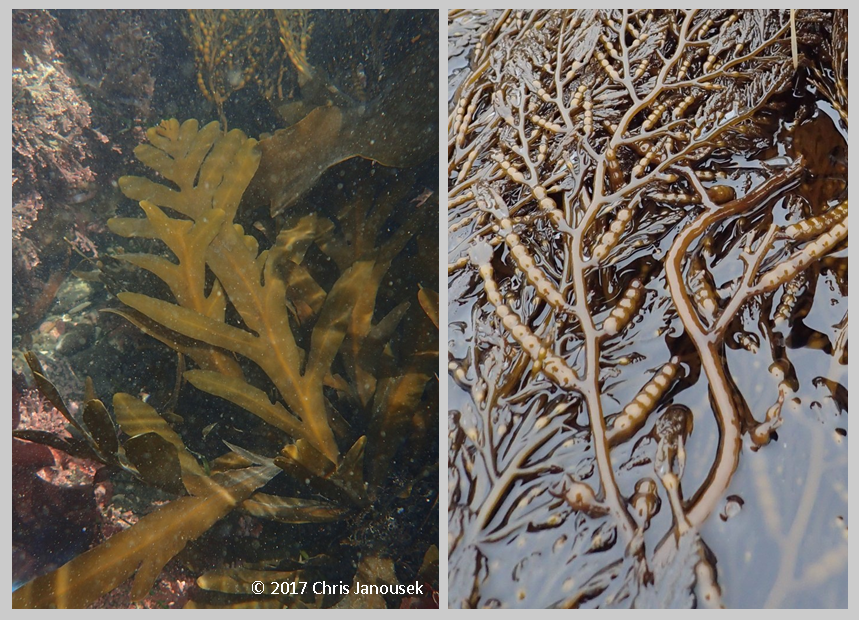
Pterygophora is a species I typically associate with subtidal kelp forests. Curiously, however it was common in the low intertidal zone at all three sites I visited in northern California for the long weekend. Another very common large brown species at Shelter Cove was Stephanocystis osmundacea (older name = Cystoseira osmundacea). Attached by a tough, almost woody base, this species is large enough to form underwater canopies like several of the kelps, but it is classified in a different order of brown seaweeds. The basal portion of the plant consists of flat pinnately-divided fronds. The top portion is more wiry in morphology and contains the most attractive part of the plant in my opinion: the concatenated pneumatocysts that look like strings of brown pearls, and which function by virtue of holding gases to keep the upper part of the plant afloat.

Stephanocystis osmundacea at Shelter Cove. Basal fronds underwater (left) and
apical portion of the plant with pneumatocysts (right).

The low intertidal into the shallow subtidal was littered with small cobbles which were covered in crustose coralline algae, brightening the substrate with pink and white. Because of their smaller size, the cobbles are likely unstable during periods of high surf, impeding any hope of long-term residence by fleshy seaweeds. The slow-growing, calcium carbonate-encrusted coralline algae however, seemed to find this sufficiently acceptable habitat.

Underwater branching and encrusting coralline algae at Shelter Cove.

In the low intertidal, a little above the water line, I soon discovered my first abalones of the day tucked into a tiny rocky ledge. There were nine individuals! In my experience, it is relatively unusual to find more than a few scattered individual abalones on any stretch of California coastline, but by the end of my wanderings that morning, I ended up counting some 77 or so over about 200 m of coastline.

Red abalones, Haliotis rufescens, in the intertidal at Shelter Cove.


The abalone hunters are well aware of the bounty present at Shelter Cove too. In fact, as I was likely the lone (bipedal) seaweed enthusiast at Shelter Cove that morning, I was quite outnumbered by divers wading in the shallow subtidal with wetsuits and donut-shaped floats looking for specimens of legal size. I have personally never tried the apparent delicacy of the expertly-prepared abalone. Despite my deep enjoyment of many things oceanic, I have generally never been too particularly interested in seafood.

Abalones are even more dedicated seaweed enthusiasts than me, feeding on kelp or other species of macroalgae. The slow-moving mollusks clamp down on a bit of sea salad as it floats by. For some species of abalone, an animal’s choice of seaweeds to dine on can be reflected in shell color. Consumption of red seaweeds, for instance, will lend the shell a reddish color from the pigment rufescine.

Abalones are gastropod mollusks, related to snails, limpets, and slugs. They occur worldwide, but attain their greatest size in the Pacific basin. Along the Pacific coast of North America there are seven species: red, black, green, pink, pinto, white, and flat.

Of these species, red abalones (Haliotis rufescens) seem to be the most common in northern California. It was this species I noted in relatively high abundance at Shelter Cove. The visible part of the tough muscular foot is black in color, protected underneath a generally pinkish to reddish pearly shell. A row of perforations near the margin of the shell are the site where gills expel water. In California this is the only species that can be fished, and even then, it can only be taken north of San Francisco, and by free diving, and during certain periods.

The only other abalone species I definitively recall seeing in the rocky intertidal is the black, H. cracherodii. I found a rare cluster of these organisms while tidepooling at Carmel Pt. south of Monterey in December of last year. Like some of the reds at Shelter Cove, these animals were wedged in a rock crevice. Black abalones occur from Mendocino County south to Baja California and can live at higher elevation in the intertidal than other species.

Black abalones, Haliotis cracherodii, in the intertidal at Carmel Pt.,
Monterey Co., CA, Dec 2016.


Unfortunately abalones tell a tale of coastal resource exploitation. After 20 years of tidepooling throughout California, my experience suggests it is relatively rare to see abalone in any significant number in the intertidal zone. Yet this was not always the case. Older photos from southern California decades ago show intertidal abalones in incredible abundance, covering much of the surface of the rock and crawling on top of each other! Overfishing, El Niño, and disease appear to have contributed to the severe loss of these important coastal ecosystem members. With declining numbers, rehabilitation of populations is now the key focus for these organisms.

Not all west coast species are equally threatened. While a fishery still exists for reds, white abalones (H. sorenseni) are so rare in the wild that they are in danger of going extinct. This species lives in southern California and Baja California in deeper waters. Whites were the first species of marine invertebrate to gain a federal listing of endangered in the United States. NOAA estimates that several thousand individuals still exist in the wild, but these adults may be the last cohort of a species at the edge of extinction. Mating success is dependent in adults being close enough to each other that sperm and eggs have a chance of meeting.

A group of researchers housed at UC Davis’s Bodega Marine Laboratory, are working hard to help recover this species. Black abalones are also federally endangered, having experienced a severe population decline in the last few decades.

References

Calif. Dept Fish Wildlife. No date. White Abalone Recovery Project.

Morris RH, Abbott DP, Haderlie EC. 1980. Intertidal Invertebrates of California. Stanford University Press, Stanford, CA.


NOAA Fisheries. 2016. White Abalone (Haliotis sorenseni).

Ricketts EF, Calvin J, Hedgpeth, Phillips DW. 1985. Between Pacific Tides. 5th ed. Stanford University Press, Stanford, CA.

Dermasterias imbricata at Shelter Cove.
Stephanocystis osmundacea from below.

21 May 2017

New seaweed finds in central California

At the end of my trip through the southwest, I shifted from National Parks and lizards and desert wildflowers to marine life of the central California coast. At tidepooling stops in Cambria and northern Santa Cruz County, I encountered two new-to-me brown seaweed species, exciting discoveries punctuating my long-term study of natural history and biogeography along the west coast.

The first new species was a high intertidal species of rockweed at Cambria in San Luis Obispo County. Rockweeds are a family of brown seaweeds in the order Fucales. Many coastal visitors (enthusiastic about slimy seaweeds or not) have likely seen these organisms since they tend to be common on rocky shorelines and live high in the intertidal zone where a good low tide isn’t necessary to leave them exposed.

Until recently, five rockweed species were recognized along the California coast (Abbott and Hollenberg 1976; Gabrielson et al. 2004; Gabrielson et al. 2012). These species are Fucus distichus, Silvetia compressa, Hesperphycus californicus, Pelvetiopsis limitata, and Pelvetiopsis arborescens. There have been several changes to the scientific names of the California rockweeds since the publication of the landmark book on California seaweeds (Marine Algae of California; Abbott and Hollenberg 1976), so I’ve included the older Latin names in the table below.


Wandering the west coast, I have seen all five of these species at various points, the rarest being P. arborescens which is only found in the vicinity of Monterey. My visit to Cambria last month was my first encounter with the sixth rockweed species, since it was newly described in the scientific literature in a paper earlier this year (Neiva et al. 2017). Maybe I have seen it before without recognizing it as a distinct species.

Two common rockweed species in California: Fucus distichus (left; Carmel Pt., Monterey Co., 2014) and Silvetia compressa (right; Scott Creek, Santa Cruz Co., 2007).

Traditionally species have been described based on their morphology, but increasingly molecular signatures are complementing, and even upending, traditional concepts of differences between species. Neiva and colleagues examined mitochondrial DNA from Pelvetiopsis and Hesperophycus, identifying a new species of Pelvetiopsis: P. hybrida.

Neiva et al.’s study resulted in some other interesting findings. First, they found evidence that P. hybrida originated because of a relatively recent hybridization event between Hesperophycus californicus and Pelvetiopsis arborescens. Up until this study, the authors note, this type of hybridization (allopolyploidy) has probably never been documented before in brown seaweeds. Polyploidy refers to chromosome multiplication inside the nucleus during a hybridization event (for instance, a hybrid progeny has twice the number of chromosomes as its parents). Allopolyploidy occurs when the two parents are from different species.

Second, the researchers confirmed that P. arborescens is a distinct species genetically, and suggested that its restricted range indicates it is a climatic relict. Finally, they found that the evidence didn’t favor placing Hesperophycus on its own separate branch on the evolutionary tree. Instead this genus seemed to stem from within the Pelvetiopsis branch, meaning that it should be renamed to be a part of that group. Hesperophycus californicus was this renamed to P. californicus in the study. 

Pelvetiopsis spp. along the US west coast. Clockwise from upper left: P. limitata (Dillon Beach, Marin Co., CA, 2008), P. californicus (Cambria, San Luis Obispo Co., 2017), P. hybrida (Cambria, 2017) and P. arborescens (Carmel Pt., Monterey Co., CA, 2017).

All those scientific name changes, annoying as they can be when trying to be a diligent student of natural history, are part of the evolution of scientific understanding and hopefully bring us to a better picture of the true evolutionary relationships among organisms over time. So, the current names for the (now) six species of California rockweeds are below:

Note that Silva et al. (2004) recognize two subspecies of Silvetia compressa: S. compressa ssp. compressa on the mainland coast of North America and S. compressa ssp. deliquescens on the Channel Islands in southern California.

At Cambria, the high intertidal rocks had populations of P. hybrida where it was pretty common. I photographed the species pretty intensely, noting that they seemed different from the usual Pelvetiopsis limitata (this species is the most common and widespread of all the species in the genus where I tend to tidepool), but I wasn’t confident I was really seeing the new species until I returned home and reviewed Neiva et al’s paper. Perhaps unsurprisingly because it is a hybrid lineage, P. hybrida is morphologically intermediate to its parent lineages. It has some cryptostomata (tufts of very small colorless hairs on the surface of the plant) like Hesperophycus, but its branches are narrower, intermediate between the two parental species. 

A mix of four intertidal rockweed species at Point Pinos, Monterey Co., 2016. Can you identify the four species?

~ ~ ~ ~

My second new seaweed find got me really excited. It was a kelp, another group of brown seaweeds in the order Laminariales. Kelps are one of my favorite groups of marine plants and after about two decades of tidepooling along the west coast, I think I’ve seen virtually every species that occurs between San Diego to Washington…except one. That would be the elusive Laminaria ephemera.

I’ve seen L. ephemera as a herbarium specimen to be sure, but until this spring I had never seen it in the wild. The magic location was Greyhound Rock in northern Santa Cruz County.

As I often do during rocky intertidal visits, I was compiling a list of large brown seaweeds (Laminariales, Fucales, etc.) present at the site, when I stumbled upon a few long kelp blades in the low intertidal that didn’t immediately register as a known species. The blades were entire (not divided), long, slender, and simple except for a really pronounced sorus (area of spore production) at the center of the blades. I initially thought of Laminaria farlowii, but the blades of that species are distinctly ruffled all over its surface. And then my mind settled on Laminaria ephemera, a species I had long known about but had never positively identified in the field.

The key feature to identify L. ephemera lies in the holdfast. Unlike most other kelp species, it has a discoid holdfast that lacks haptera (spreading branches that superficially resemble plant roots). The holdfast is essentially a small golden brown suction cup that anchors the plant to a rock. Gently moving aside some of the algal cover around the base of the plant, sure enough, I could see the small smooth holdfast.

Laminaria ephemera at Greyhound Rock, Santa Cruz Co., CA, April 2017. Left: Blades. Right: close-up of discoid holdfast.

The population of L. ephemera I discovered was of unknown size, but it didn’t seem large from my observations. There were about 10 blades that seemed to meet the visual criteria for the species, and I checked about half of those to verify the presence of the correct holdfast. There were smaller kelp blades in the low intertidal that could have been less mature plants of the species, or possibly specimens of L. sinclairii or L. setchellii, both of which were also present at the site. The challenge with identification of the kelps is that the juvenile sporophytes all look terribly similar, regardless of species.

Two blades of L. ephemera with sori (regions of a seaweed blade that produce spores) at Greyhound Rock, April 2017.

How would a large seaweed like L. ephemera be hard to miss? A few reasons perhaps. First, as one of the few annual kelps, L. ephemera would quickly mature and then disappear after several months of growth. It would be an unlikely find in the fall or winter. Second, blades might be easily confused for small plants of L. setchellii (before the blade begins to divide into individual straps) or L. sinclairii. One would have to check every holdfast to distinguish L. ephemera from related kelps. Finally, L. ephemera appears to be fairly rare along the west coast of the US. Abbott and Hollenberg (1976) note that it is present from Alaska to Monterey County, but also call it “infrequent”. Reviewing herbarium records available on-line at the Macroalgal Herbarium Portal, in California this species seems to have mainly been collected from Monterey and Humboldt Counties, so my finding of a small population in northern Santa Cruz County may possibly be a new location for this species. This is a species I’d like to study further in terms of prior collections, and … I need to check more kelp holdfasts in the field!

References

Abbott IA, Hollenberg GJ. 1976. Marine Algae of California. Stanford University Press.

Gabrielson PW, Widdowson TB, Lindstrom SC. 2004. Keys to the seaweeds and seagrasses of Oregon and California, north of Point Conception. Phycological Contribution No 6.

Gabrielson PW, Lindstrom SC, O’Kelly CJ. 2012. Keys to the seaweeds and seagrasses of southeast Alaska, British Columbia, Washington, and Oregon. Phycological Contribution No 8.

Macroalgal Herbarium Portal. 2017. http://macroalgae.org/portal/index/php. Accessed 16 May 2017.

Neiva J, Serrão EA, Anderson L, Raimondi PT, Martins N, Gouveia L,Paulino C, Coelho NC, Miller KA, Reed DC, Ladah LB, Pearson GA. 2017. Cryptic diversity, geographical endemism and allopolyploidy in NE Pacific seaweeds. BMC Evolutionary Biology 17:30.

Silva PC. 1990. Hesperophycus Setchell & Gardner, nom. cons. prop., a problematic name applied to a distinct genus of Fucaceae (Phaeophyceae). Taxon 39:1-8.

Silva PC, Pedroche FF, Chacana ME, Aguilar-Rosas R, Aguilar-Rosas LE, Raum J. 2004. Geographic correlation of morphological and molecular variation in Silvetia compressa (Fucaceae, Fucales, Phaeophyceae). Phycologia 43:204-214.