Showing posts with label wilderness. Show all posts

08 May 2022

Death Valley: Wildrose Peak

The deserts of southeastern California and Nevada are expansive, and their large size is driven home by the maze of valleys, canyons, and mountain ranges that add complexity to the landscape. The Panamint Range runs from north to south at the western end of Death Valley. It is a relatively high range, with several peaks over 9000 ft, but it becomes even more prominent in consideration of its position between two low desert valleys to the east (Death Valley) and west (Panamint Valley). In fact, the highest peak of the range is Telescope Peak at over 11,000 ft, which is just miles from the lowest point in North America: Badwater Basin in Death Valley at nearly 300 ft below sea-level.

I set out to Death Valley National Park in late February for a photography project, with just a general concept in mind, and few set destinations. After a first night in the backcountry in northern Panamint Valley and an easy hike to Darwin Falls the following morning, I decided to travel down Emigrant Valley Road, find a campsite at Wildrose campground if available, and continue the drive up Wildrose Canyon. By mid-afternoon I was far up the canyon past the start of the juniper and pinyon pine tree line, and at the start of the trail to Wildrose Peak. I grabbed several cameras and started the hike.

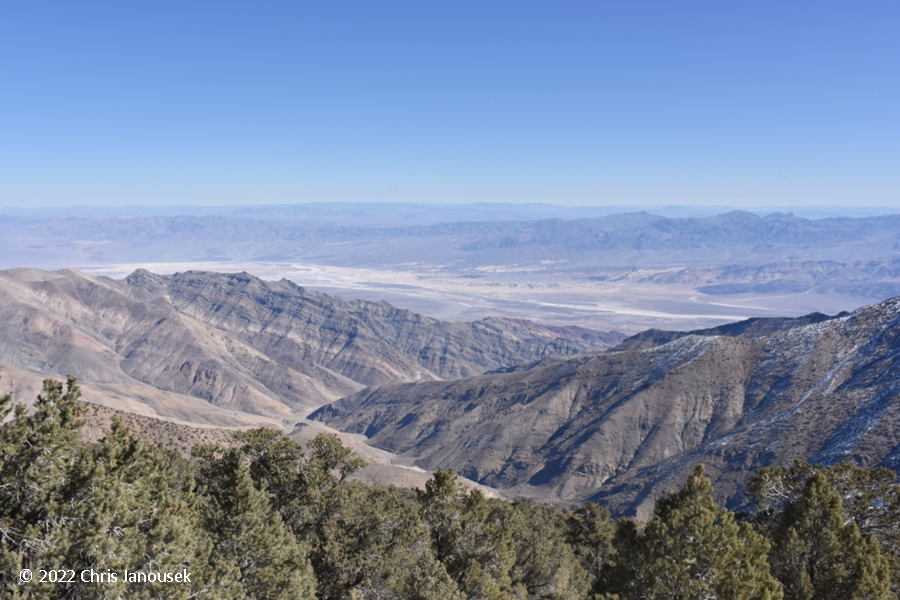
Unfortunately I started too late in the day to make it very far along the trail, but I returned the next morning arriving at the trail head by 7:30. It was cold: 22°F according to my car! Starting up the trail again I passed junipers, pines, and patches of snow. The sun was rising in the east and broke through for a moment, providing some welcome warmth. I climbed towards the east and at an elevation of just under 8000 feet I arrived at a ridge that provided an expansive view of Death Valley to the east. Sunshine was now a regular companion on the trail, and though the air was still cold, it make the hike more enjoyable.

The trail continued to the north and then back to the west, ascending a bit more than another 1000 ft before it would end at Wildrose Peak. Snow patches were common, but in most places they were a thin crust on the cold ground, unlikely to provide much water at all once they melted. The snow may have fallen earlier in the week when California finally – after a remarkably dry January and February – had a winter storm pass through the state. On my drive from Davis through the Central Valley I caught a bit of the storm in Tehachapi Pass where rain, hail, and snow were falling.

The top of Wildrose Peak afforded incredible views of the southwest desert landscape. To the east Death Valley and the Amargosa Range were visible, and Nevada could also be seen including a distant peak with some snow to the east. The lower elevation Panamints were to the north. To the south, Telescope Peak, the highest point of the Panamint range, dominated. Though that mountain was also dotted with dark green evergreens (presumably also junipers and pines), it seemed to have a thicker blanket of snow. To the west was the Panamint Valley and then other mountain ranges, including I’m almost sure, a distant ridge of jagged snow-covered mountains that must have been the eastern edge of the Sierra Nevada.


Death Valley to the east

The mountain top at Wildrose Peak had a rock cairn, USGS benchmark, and a metal box with a logbook. A raven was perched at the top of the cairn for sometime before flying off. The mountain top was rather rounded, like the other nearby peaks in the Panamint range. The smoother summit topography perhaps indicates a more ancient origin, with millions of years of erosive forces mellowing the mountains in their old age. While evergreens reached to about the summit of Wildrose, the vegetation was rather low lying and sparse, the species most catching my eye was a prickly pear cactus with long spines, the clusters of stems lying close to the ground and mixed in with snow patches and rocks.


Crest of the Sierra Nevada range to the west

Wheeler Peak to the south

Cairn at the summit of Wildrose Peak


13 July 2019

Napali coast


The Kalalau trail traverses the famous northwestern coast of Kaua’i in what I presume is one of the most scenic hiking trails anywhere in the United States. The first two miles are open to day hikers and a backpacking permit is required to venture further. Because of recent flooding however, the whole trail was closed during our visit to the island last fall.

That unfortunate news left just a few other options to see this dramatic coastline. We availed ourselves of two of these: ridge-top hiking trails accessible from Kokee State Park, and offshore views of the coast from the sea on a chartered boat tour.

The Napali Coast reminds me of Big Sur in central California where in both cases steep coastal mountains abruptly meet the gorgeous Pacific Ocean. The mountains of the Napali coast are more deeply sculpted and luminous than Big Sur, but both are examples of breathtaking coastal wilderness.

Napali coast cliffs from offshore.

Spinner dolphins astride the boat near the Napali coast.
Our first views of this area were by charter boat that left early in the morning from the port on the southern side of the island. A very long sandy beach in southwestern Kauai suddenly gives way to the deeply incised ridges and valleys that rise to several thousand feet above the Pacific. A large pod of spinner dolphins milled around the tour boat, swimming near the bow and leaping out of the water.

We pulled closer to shore at several locations along the Napali coast and anchored at one for a chance to snorkel offshore. The site was in about 10 m of water though I swam in towards shore with my two older kids to a shallower area. Water clarity was decent, though I enjoy swimming in pretty shallow areas when possible because they offer more opportunity to see the small biota on the reef. I was about the last person to hop back on the boat, hoping to spend as much time as possible in the water.

Fishes at our snorkeling spot along the Napali coast.

Our other views of the Napali coast were from above. One must actually circle all around the island from the Kalalau trail, head up the steep road that traverses the west side of Waimea Canyon, and access one of the trails that descends down the mountain ridges from the state parks.

View from the Awaawapuhi trail.
We descended down onto one of the ridges via the Awaawapuhi trail. The coast wasn’t visible at all for the first two miles or so but then the trail ran along a narrow saddle with ravines to the north and south. After another mile and a half it ended, and opened up to a spectacular view of the Pacific from a high point with views to the north and south. A rainbow graced the coastline to the north for a few minutes.

I actually ended up taking a second excursion to the Napali Coast offered by a different tour company. My main interest in this second tour was the destination of Lehua Rock off the north shore of Nihau where the group would be allowed to snorkel. However, before we even departed we were told this might not be possible due to rough seas, and a short time later on the water, that disappointing news was confirmed. We viewed the Napali coast again, but did not even snorkel there, rather stopping at a small cove near the harbor. I now have two excellent excuses to visit Kaua’i again – the Kalalau trail and Lehua Rock!


Small coastal waterfall.
Spinner dolphins.

Rainbow at the end of the Awaawapuhi trail.


19 May 2018

Carlsbad Caverns backcountry


One of the best ways to experience the National Parks is in the backcountry, off the beaten path. There is a time and place for the more curated nature experience, the “park” component of the National Park System, and frankly is the only way of engaging with some of the most iconic geologic features of the parks. At Carlsbad Caverns for example, it seems unlikely one could ever tour the caverns without running into a fair number of people. Similarly, if the grandeur of Yosemite Valley is to be experienced, it usually has to be shared with the crowds that assemble beneath its most iconic features.

Rattlesnake Canyon, Carlsbad Caverns National Park, April 2018.

Yet the backcountry of many national parks offers another treasure: solitude. It is a commodity in increasingly short supply in today’s noisy and hyperactive world, and one that seems to be vastly underappreciated given how few park visitors are willing to get off the paved trails and away from the visitor centers.

During my spring trip through the Southwest I was fortunate to backcountry camp at White Sands and Carlsbad Caverns in New Mexico, and later on, at Bryce Canyon in southern Utah. The latter two parks offered an opportunity for a night of complete solitude where I was likely the only person out in the wilderness within miles. At Carlsbad Cavers I hiked into Rattlesnake Canyon from a dirt loop road winds through Chihuahuan Desert habitat west of the entrance to the caverns.

Unopened flowers of ocotillo, Carlsbad Caverns National Park, April 2018.


Texas walnut growing in a dry wash.
The region around Rattlesnake Canyon is a collection of rounded mesas dissected by winding canyons, not unlike the topography I remember from the southern part of Mesa Verde National Park. Ocotillo, prickly pear cacti, and shrubs grew throughout the dry slopes. It wasn’t as colorful as the Sonoran Desert vegetation I observed just days before in Saguaro National Park, but the blooming ocotillo added some vibrant color to the desert scrub.

At the bottom of the valleys were water would be more frequently available (no water was to be seen at all during my visit) small trees – Texas walnut (Juglans microcarpa) grew. One of the more interesting plants to catch my attention, growing throughout the park, was “sotol”, an interesting yet forbidding plant that grows in basal rosettes of pointed leaves like some species of Yucca. The long slender leaves bear sharp hooks which are very adept at catching clothes.

Sotol is formally Dasilirion wheeleri, and a member of the Asparagaceae family. Yucca, which it resembles in overall growth form is actually in a different plant family, the Agavaceae. Interestingly sotol has been used to produce both beer-like and distilled alcoholic drinks. Fibers of the plant were also useful to the Ancient Puebloan people of the Chihuahuan Desert.

Sotol, Carlsbad Caverns NP, April 2018.
Barbary sheep near the entrance to Carlsbad Caverns National Park. This species is non-native
and was introduced into the area from northern Africa.


25 April 2018

Arizona cacti


Heading east from San Diego I descended into the hot Imperial Valley and the Sonoran Desert. Ocotillos appeared signaling entry into this desert province. After a relatively cool spring in northern California, I wasn’t quite ready to be thrust into summer temperatures. My first major destination was Organ Pipe Cactus National Monument, just north of the Arizona-Mexico border. It lies right in the heart of the Sonoran Desert.

Organ Pipe and other cacti at Alamo Canyon.


Night sky at Organ Pipe Cactus National Monument.
I first visited Organ Pipe 20 years ago, when with a class of UC Santa Cruz students we descended on northern Mexico to study the ecology of the Gulf of California. The road to Sonoyta, Mexico passes bisects the monument. I arrived after dark, and turned up a dirt road to a small campsite at the head of Alamo Canyon. It was a warm evening. I stayed up for some time photographing landscapes dominated by Saguaro cacti. A half moon shone brightly in the sky above but was gone by 4 AM when I awoke again to photograph stars and the Milky Way.

With the new day, the diversity of cacti was evident from the start. Saguaros were very common, and organ pipe cacti became more common as I made my way up the valley for a morning hike. There were menacing cholla cacti, with their beautiful golden spines covering plants like a blanket. I also recognized the prickly pear cactus, Opuntia.

The organ pipe cactus (Stenocereus thurberi) is a collection of rather large stems, emerging from a common base. The namesake of the monument, the species is more common in Mexico than in the US and has a limited presence here due to its intolerance of frost. Flowers apparently only open during the night and are primary pollinated by bats.

Saguaros (Carnegiea gigantea) were actually very common at Organ Pipe Cactus NM, growing in most regions of the monument that I observed. However, there is a whole national park named in honor of this species, and that was my next destination. Bisected by the city of Tuscon, Saguaro National Park comprises two units east and west of the city. I briefly visited some of both, catching the sunset at the west unit and doing some morning hiking at the east unit.

Saguaro cacti. Left: spines (which are actually modified leaves on cacti) on a plant at Saguaro NP. Right: An open flower on a plant at Organ Pipe Cactus NM.


The morning of my hike started off warm. I began at a trailhead at Loma Verde and hiked about 2 miles into the Saguaro Wilderness along the Squeeze Pen and Carillo trails. Saguaro, barrel cacti, and Opuntia were common. Mesquite, palo verde (literally, “green stick”), and other trees and shrubs were also abundant in the area. At Wildhorse Canyon I found pools of water remaining in a wash.

Flowering cholla cacti at Saguaro NP. At left is the pencil cholla, Cylindropuntia arbuscula.


Though not a cactus, ocotillos were common at both Organ Pipe Cactus and Saguaro NP and were frequently in bloom, their bright red flowers adding color to the landscape. At Saguaro I saw many ocotillos with leaves (some green, some senescing), a sight that may not be particularly common since these plants readily shed their leaves during times when water is scarce. It is a true deciduous desert species.

Ocotillos. Left: With leaves at Saguaro NP. Right: Hummingbird visiting flowers at Organ Pipe Cactus NM.

Wildlife was fairly common at both of these desert parks. I saw coyotes (Organ Pipe), a Gila Monster (Saguaro), a hummingbird (Organ Pipe) and other birds, a deer (Saguaro), Desert pupfish (Organ Pipe), and lots of lizards (both parks).

Barrel cactus, Ferrocactus, at Organ Pipe Cactus NM.

Chainfruit cholla cactus, Cylindropuntia fulgida, at Organ Pipe Cactus NM.

An organ pipe cactus near the US/Mexico border that is half skeleton at this point.

Prickly pear, barrel cactus, and saguaros at Saguaro NP.

Sunset with Saguaro cacti and ocotillo at Saguaro NP.


24 September 2017

Carson-Iceberg Wilderness

Folger Peak from the Carson-Iceberg Wilderness.
After a hot California summer (one for which I was admittedly away for a decent portion), fall appears to finally be here. There are cooler temperatures in the Central Valley and day length is noticeably shorter.

Last weekend I ventured to the crest of the Sierra for a short excursion into the Carson-Iceberg Wilderness, one of the more northerly of the string of wilderness areas, national parks, and national monuments that protect much of the Sierra Nevada. The Carson is south of the Mokelumne Wilderness and north of Emigrant Wilderness and Yosemite National Park. It straddles the crest of the mountains that Muir called the “Range of Light”, incorporating part of the Humboldt-Toiyabe National Forest to the east and the Stanislaus National Forest to the west. The name of the wilderness derives from an early California settler (Kit Carson) and a unique rock formation within the wilderness (named Iceberg).

Map of wilderness areas in the Sierra Nevada
range. Map from sierrawild.gov.


I hiked into the wilderness with B from the Tryon Meadow trailhead. The trail was not very distinct in places, and therefore probably not frequently used, but obvious enough to not get steered too far off course. It passed through lightly dense forests of pine and firs, crossing a few very tiny streams. Some remnant patches of snow lingered on the western flank of Folger Peak, but the evidence of the very wet 2016-2017 California winter was otherwise gone.

We ended the hike at Milk Ranch Meadow, a lovely expanse of sedge-dominated wetlands occupying a broad valley. The lush yellow-green Carex swayed with the mild gusts of wind. The air was cool, but there was a clear sky full of warming sun. Open water in the form of a small lake and even smaller ponds occurred within the Carex meadow, and the wetland itself had standing water.

I spent about an hour trying to photograph dragonflies busy with activity over the wetland. I walked out on to the white skeleton branches of a fallen tree that penetrated into the wetland like a decaying pier. There appeared to be three dragonfly species: a rarer black form, a smaller red species, and a larger blue species that occupied much of my time. The red species was relatively easy to photograph because it would land patiently on the tree branches. The blue species, however, was constantly in motion, hovering above the sedges for a second and then descending into the vegetation, then pairing with a friend (or competitor) to dash off to a new spot above the meadow. They moved nearly constantly, seldom landed, and often mid-flight took a sharp turn to move in a different direction, all aspects of behavior that made them a keen challenge to capture by camera.

The blue dragonfly species.
Wetland at Milk Ranch Meadow.
The wilderness and adjacent national forest had a variety of flowers in bloom, including a very abundant species of pink Sidalcea, blue lupines with large palmate leaves, Spiraea splendens, and yellow and blue asters. Ipomopsis aggregata showed off its flame red flowers, with a long floral tube and five sharp pointed petals.

The high Sierra had some signs of the approaching fall season like a few hints of yellowing branches on the otherwise green aspens. The abundant corn lilies (Veratrum californicum) with their poisonous leaves, growing in patches in open areas, were well on their way to senescence too. Snow apparently returned to the Sierra over the past few days, and while the initial dusting may melt, soon the high peaks will be blanketed again. In the fluctuating annual precipitation regimes of California, and the longer-term pressure of a changing climate, will this year being a return of drought conditions, another wet year, or something closer to the long-term average?


References

Wenk E. 2015. Wildflowers of the High Sierra and John Muir Trail. Wilderness Press, Birmingham, AL.

Wilson L, Wilson J, Nicholas J. 1987. Wildflowers of Yosemite. Sunrise Productions, Yosemite, CA.

The red dragonfly species.
Ipomopsis aggregata (Polemoniaceae) at left and Sidalcea sp. (Malvaceae) at right.

19 August 2017

Wilderness: An enduring resource

Three Sisters Wilderness, Cascade Range, Oregon, 2012.
Over the course of working on this blog for the last six years, I have shared thoughts and photos about the natural history of the western US. I have touched on science here and there, and tried to describe my natural history experiences in a way that educates and inspires. With “wilderness” the operative word in the title of this journal, I’ve wanted to discuss the broader meanings of the concept and offer some additional thoughts about what the idea and experience of wilderness mean to me. In short, it is past time to offer a preface to the central theme of this blog.

Wilderness refers to specific places, an idea intimately tied to space. These are areas of land (usually) or volumes of ocean that are distinguished for their intrinsic “naturalness”. That naturalness is a matter of degree as much as kind in the modern world, because every geographic place is simultaneously somewhat natural and somewhat unnatural in character.

Most of us have an intuitive sense about the difference between natural and unnatural, but what about wilderness? Is it something more than simply a natural area, perhaps a manifestation of nature in a unique state? Does it include areas where human beings infrequently reside such as rural areas or parks? In the 21st century with near total human dominance of the planet, does wilderness even exist?

The Wilderness Act of 1964, enacted to preserve specific US federal lands as wilderness, offers a starting point in terms of understanding how wilderness might refer to something more specific than simply “nature”. With preservation as a focus, the Act defined wilderness as “an area where the earth and its community of life are untrammeled by man, where man himself is a visitor who does not remain”.  In its quality, wilderness is meant to be “unimpaired” and in its scope it is intended to be an “enduring resource”, even if specific areas are rather limited in their geographic extent.

Joshua Tree in Death Valley National Park, 2016.
Most of the park is designated wilderness.
While the practical application of the Wilderness Act was to set aside certain land areas in the United States as wilderness, the Act also lays out wilderness as a concept. That notion did not just suddenly appear 50 years ago, but was almost certainly the evolution of many years of thought about the interaction between humans and nature stretching back to Muir and beyond. Conceptually wilderness touches on science, law, and aesthetics. On a personal level, it also embodies certain values for me, in much the same way that liberty and knowledge are cognitive and emotional guideposts which center and structure my life.

The Act’s brief definition of wilderness pivots on the presence and impact of humankind, for example, prohibiting roads or permanent structures in designated wilderness areas. The absence of human-kind and our infrastructure could be the simple criterion for wilderness. However, our activities are important too, and the Act suggests (or is at least consistent with the notion) that the predominance of natural processes distinguishes wilderness from non-wilderness areas. A farm, for instance cannot be wilderness, because the processes affecting the area’s hydrology, vegetation, and soil are all dominated by humankind.

Another way to think of wilderness, admittedly from a biologically-centered perspective, is as a collection of organisms in an ecosystem that in their composition and abundance are relatively unaltered by human activity. This definition allows for the recognition that virtually every ecosystem today has at least some non-native species present. But if species composition in an area is predominantly native (i.e., non-endemic species are a minor and unobtrusive component), we might capture some of the sense of what constitutes wilderness. Non-native species are of course natural, but they are not present outside their endemic range without human activity as a vector. By this definition, a farm fails too because its plant species are non-native, its native fauna is consequently altered by the change in vegetation, and its soil microbial community would be expected to deviate too from natural composition by farming practices.

Wilderness also evokes a sense of pristine, primitive, and pre-historic, each of these qualities being the antithesis of the presence of humankind. When nature exists in such a state, we might learn about how organisms interact in ecosystems prior to, or absent from, pressures added by human activity. In theory, such examples might be windows into how prehistoric ecosystems functioned. In reality, our influence is pervasive and even the most extensive tracks of wilderness cannot be completely regarded as independent of our activities, past and present. Wilderness areas may lack current human intervention, yet they may deviate from their prehistoric condition because they have been altered by past activities such as removal of top predators across large geographic areas.

Madrone in the Ventana Wilderness, central California, 2015.

I’m not partisan to any of these ways of considering wilderness. I think both the functional (processes) and structural (native biota) definitions have merit (and probably would usually point to the same conclusions about whether an area is wilderness or not). They highlight that humankind affects nature in different ways – from alteration of local natural processes (hydrology, productivity), to changes in regional species composition (species invasions), to diffuse but widespread impacts (climate change, chemical and light pollution). The preservation of wilderness as an “enduring resource” hinges on minimization of these impacts at a range of scales.

For the rest of this essay, I turn to an exploration of the ways in which wilderness helps articulate some of my personal values and outlook.

First, wilderness exemplifies what I feel is the proper relationship between our species and the other millions of species that occupy Earth. True, as a species we need wood for timber, land for habitation, and farms for food, but the scale of that exploitation is in our hands to determine through choices about our population size and the relative care with which we use and recycle resources. Wilderness reminds us, for our own sake and the eventual destiny of other species, to step back, and to eschew overindulgence. It reminds us that our species can and should have other objectives besides complete dominance of the biosphere. While no other species exists with any specific raison d’etre inherent in its existence, our relative consciousness and awareness places us in a unique position of self-reflection and regulation, one which can be employed for our own long-term well being. On a personal level, wilderness reminds me to balance the impulses of competition and exploitation, with an ethic of limiting impact, respecting life, and eschewing waste.


John Muir Wilderness, Sierra Nevada Range, CA, 2017.

Wilderness reestablishes a proper sense of scale for us as a species. It invites us to correct the flattery we heap upon ourselves with regard to our power, influence, and importance. A marvelous, ingenious, and conquering species we are. But next to a bristlecone pine, we are but a brief acquaintance; next to a microbe that can fashion its own food in a boiling sulfur spring, we are metabolically feeble; next to the efficiency of social insects, we are a disorganized and discordant lot. In scale, no human engineering feat compares to the tidal forces that shape coastlines, or the oxygenation of the entire atmosphere by the microscopic ancestors of cyanobacteria two billion years ago. There are other organisms that run faster, swim better, endure harsher temperatures, or exhibit enviable self-sufficiency by unfurling a leaf towards the sun to make their own food. Our species is not less impressive than the other millions inhabiting Earth, but it is not more marvelous either. In wilderness we can be reminded of that humbling perspective and adjust our conscious feelings toward, and interactions with, nature accordingly.
Vine maple in the Menagerie Wilderness, OR, 2012.

Next, wilderness embodies perhaps the most fundamental aesthetic by which our artistic proclivities are enlightened. Isn’t art built in large measure from the harmonies, shapes, forms, and colors nature has already invented? Imagine the painting made by the light streaming through a vine maple growing in the forest understory, its delicate sprays of palmate leaves dancing lightly with the breeze, and leaves glowing the most vibrant green. Each such vine maple painting in each forest is transitory and unique, evoking our aesthetic wonder. Each day such forests change slightly in composition, and in a generation, a vine maple seed will start the process of painting a whole new sculpture of lignin and chlorophyll.

Wilderness invites simplicity which can be one of the most powerful expressions of art, like those embodied in the Zen aesthetic. While in nature, I’m often drawn to the complexity of a beautiful landscape – the collective view of clouds, mountains, forest, snow, and flowers – but perhaps I’m inspired even more so by the simpler patterns in nature such as a dark mineral seam coursing through the surface of granite bedrock, or a repeating pattern in nature (coupled with just a touch of random organization) in the clouds, snow, or water surface.

The inhabitants of wild places model simplicity for us too – their simplicity is one of purpose. An organism’s basic programming is only essentially to survive, grow, and reproduce. But to our good fortune, nature succeeds in accomplishing these simple purposes with great beauty. Few would find interest keenly observing a friend eating, but how we would readily watch a herbivore graze on delicate meadow plants or a predator adeptly approach its prey in perfect stillness.

Third, wilderness reminds us of renewal and impermanence. It shows us that new life and new composition inevitably follow death and decomposition. As a species, our spirits are renewed in the wild. We are re-encouraged, reinvigorated, and rejoice. Continuity of life is manifest in this cycle of renewal, not in any one organism, mountain, or river, but in the collective. Nature teaches that impermanence is the most consistent attribute of life at any scale. The closest that nature may come to impermanence may be the constancy of her change, the relentlessness with which she shapes and reshapes rocks and mountains and the ever evolving web of life. As humans, we all participate in this relentless change, and whatever barriers we might construct between each other or between our species and the rest of living earth, we are inexorably united as participants in change, in being subject to the ever-changing flow of matter and energy through nature.

Recognizing the inevitability of impermanence, wilderness helps set a sustainable pace and tempo. So much of our modern society is too frantic, too focused on the inane. True, the twists and turns of our lives are just as transitory as the flow of water through a creek or the birth and death of deciduous leaves, but how often do we mistakenly view the mundane details of our lives with a level of importance they do not merit? We can humbly dedicate the small acts of our lives towards a greater human ecosystem.

The paradox of wilderness is that it excludes humans by definition, but we of course are the product of nature too, formed by the same evolutionary forces that have shaped other millions of species over billions of years of Earth’s history. Our natural origins notwithstanding, wilderness warns us of the danger we pose to ourselves and to the rest of life. We can be destructive, violent, impetuous, and perverse, propensities which are unlikely to end all of life on Earth, but which could certainly end our own geologic tenure as a species or make continued existence a lot less pleasant for our descendents. Wilderness is threatened by our ever expanding global reach, and we stand to lose not only nature’s evolutionary treasures but the values they model for us. Let’s recognize the irreplaceable value of wilderness and preserve it as an enduring resource.


- Summer 2017. Mt. Rainier National Park, WA; John Muir Wilderness, CA; Portland OR.

Bandelier Wilderness, Bandelier National Monument, NM, 2017.

26 April 2017

Bandelier National Monument

Bandelier is a small gem located in the mountains northwest of Santa Fe in northern New Mexico. It is close to Los Alamos National Labs and the Valle Caldera. The park preserves both archaeological features of the Ancestral Pueblo people (much like Mesa Verde), and a mountainous landscape of forest and high desert savannah.

Cave dwellings at Bandelier. A few are open to visitors via ladders. Ar right: view from a cave dwelling with the ruins of a settlement in Frijoles Valley visible below the forest.

Starting at the visitors center, I took the main trail to see the ruins of the village and the cave dwellings that the former inhabitants carved into the soft sandstone rocks that line the northeast side of Frijoles Valley. Unlike Mesa Verde, visitors to the park are allowed to enter some of the dwellings without special tickets. I climbed into a few of the tight chambers with their natural rock windows and blackened ceilings from ancient fires. The people who used to inhabit Bandelier also used stone bricks and mortar to build living structures and kivas (ceremonial chambers) adjacent to the cliffs or on the valley floor.

View of Frijoles Valley from a sandstone alcove where the ruins of a ceremonial Kiva were located. Inset at right is a NPS diagram of the layout of the kiva.

Box elder with developing fruits.
I continued hiking up Frijoles Canyon beyond the archaeological attractions into the Bandelier Wilderness. Frijoles Creek, a very narrow creek, ran with cool water. The valley from the visitors center up into the wilderness was well forested, mainly by ponderosa pine (Pinus ponderosa; needles in bunches of three) and box elder, a broadleaf tree that produces winged samara fruits like maples. There were other tree species too including gambel oak (their lobed leaves  are shaped like the valley oaks that I am used to in California), Douglas fir, narrow-leaf cottonwood, and maybe species of Salix and Tamarix

The valley had a number of blooming species of plants too including a lovely shrub (western chokecherry, Prunus virginiana). Each plant had numerous inflorescences several inches long with dozens of fragrant white flowers. Another very attractive species growing in forest areas was a member of the pea family (golden pea, Thermopsis rhombifolia), having spikes of yellow-flowers (suggesting a species of lupine), but leaves with three main leaflets (unlike other lupines that I am familiar with where there are typically many leaflets). In the more open grasslands, an attractive aster, with golden and red ray flowers could be found.


Reference

Blackwell LR. 2006. Great Basin Wildflowers. The Globe Perquot Press, Guilford, CN

The very fragrant and beautiful flowers of Prunus virginiana.
Frijoles Creek.

Left: Ruins of a village built at the base of the cliff wall. The parallel series of holes in the sandstone cliff are where wooden beams used to extend over the buildings. Right: Natural sandstone sculpture and valley ruins.

30 October 2016

Muir: advocate for the wild

At a bookstore in Portland in July I purchased a biography of John Muir by history professor Donald Worster. An excellent book, I gradually read it over the last few months. For a decade Muir has been a significant role model for me. My first substantive introduction to his writing was towards the end of graduate school when my mom bought me a book with a collection of his writings. Muir's romantically-infused view of nature, his attentiveness to natural history details, his wit regarding our own species, and his deep love of nature's beauty all resonate deeply with me.

President Teddy Roosevelt and John Muir at Glacier
Point overlooking Yosemite Valley in 1906. Image
in the public domain.
Muir is widely regarded as the godfather of Yosemite, of the National Park System, and of wilderness as a human value. He grew up in Scotland in a stern religious household, immigrated with his family to Wisconsin during childhood, and began to study science at the University of Wisconsin, though he did not complete his degree. The youthful Muir was an inventor and interested in mechanical innovation and efficiency. For instance, he built several versions of an alarm-clock bed that would rudely tip him to his feet at the appointed time early in the morning! His early career was spent in factories where his proclivity towards innovation bore fruit, but that left less time for indulging in his interests in science. An alarming accident in the factory that nearly blinded him helped him re-evaluate his life’s direction. Muir soon thereafter gave up factory work, moved to California – and scarcely giving any attention to the shiny city of San Francisco where his ship landed – headed for the Sierra Nevada.

Muir would end up spending years living in and exploring Yosemite and the nearby Sierra range. Though he lacked higher academic credentials, he would eventually help decipher from the rocks that the great valleys of the Sierra were formed by the slow action of glaciers, even though leading geologists of the time tended to favor other, incorrect theories. Muir also traveled beyond his beloved Yosemite to other regions of the west - to Mt. Rainier, to the Great Basin, and on seven different trips, to the recently acquired US territory of Alaska.

A panorama of forest in Sequoia National Park, August 2014. Crowns of giant sequoias (Sequoiadendron giganteum) in Muir Grove can be seen at top center. From a glacier to a wilderness area in the Sierra, to a beach, Muir has numerous natural landmarks named after him throughout the western United States.


Worster’s biography shed some light on aspects of Muir's life that I didn’t know or that I under-appreciated. By hard work and financial thrift, he gradually grew into a life of significant financial and social comfort by his later years. This was an interesting point of contrast for a man who was perfectly happy to sleep outside below the stars or who packed little but tea and bread for several days of wandering in the wilderness. In addition to his exploration throughout the western US, he also took several long international journeys (traveling to most continents) and he spent a significant amount of time in the deserts of the southwest, though he is mainly known as the patron saint of the Sierra. Finally, I learned that he actually camped with not one, but two, US Presidents who made visits to California (Roosevelt and Taft).

Muir's life was a celebration of nature, and on the time scale of history he had a tremendous impact on conservation and natural resource protection, but his life ended on a sad note. For years, he was involved with others in a political battle to save the beautiful Hetch Hetchy valley in Yosemite National Park from drowning under San Francisco's uncompromising push for urban growth and consumption. For a time it seemed that the proposed dam Muir strongly opposed would be put on hold for at least a generation, but in the end other political forces prevailed and Yosemite Valley’s northerly twin granite cathedral was allowed to drown to become a reservoir. The valley remains underwater today.

Muir epitomized aesthetic love of nature, but he was a pragmatist too and did not object to mankind’s use of natural resources or natural areas. His lifetime spanned a great period of technological and engineering advances (the mid 1800s to early 1900s), which perhaps accelerated the pace and degree to which human intervention in the natural world could leave lasting imprints. He was favorable to industrial advances, but he advocated for a much greater emphasis on conservation than most of his contemporaries. He didn’t see industrial or agricultural progress as an enemy, but rather recognized that true human progress depended on a deep reverence for, and sufficient protection, of nature. Today, he would likely be astounded at just how far humankind has impacted every ecosystem on earth, but perhaps he would also be relieved that his successors have set aside some of the most inspiring natural places as wildernesses and national parks.

----

I stumbled upon Muir’s old mansion in Martinez, California inadvertently this summer while car shopping. Just off the highway, a National Park Service sign appeared across the road which marked the house and orchards where Muir spent the last decades of his life. It was originally owned by his father-in-law but eventually came to be owned by the naturalist. After an uneventful visit to the car dealership, we stopped at the visitor’s center and then toured the house and grounds.

The Muir mansion in Martinez, California. The photo at right is Muir's office, which he called his "scribble den".

The Muir-Strentzel mansion is perched on the top of a small hill. It is spacious with several stories, a large kitchen, a green-house like room on the east side of the building, and a small bell tower. There are fancy chandeliers. Muir had an office on the second floor across from his bedroom where a desk sat below windows that open up to the Alhambra Valley to the north. Here he worked on patching together old field notebooks and other scraps of text into the wonderful nature writing we have today.

Out on the grounds the fruit trees have been preserved by the Park Service, perhaps including some of the original trees that Muir, his family, and hired workers tended. He was a successful and hard-working business man, turning a good profit on the property. The mansion and grounds are not the expected scene of a lover of all things wild. Yet, down the slope from the house also grows a single tall Sequoiadendron giganteum specimen too, planted by Muir.

----

Writing apparently came with great difficulty to Muir, though in books like My First Summer in the Sierra, I've felt his words flow with grace and ease. He frequently used superlatives, even religious language, to describe the landscapes impressed on his mind. To Muir, the geologic labor that built cathedrals like the Yosemite Valley was superior to anything humankind could construct. His early writings consisted of articles for periodicals published on both the east and west coasts. He was able to introduce the marvelous natural areas of the west to eastern readers who had never seen the less-densely populated areas of western North America. His books tended to emerge later in his life (or even shortly after his death); in some cases they were re-workings of his shorter essays.

A photo of Hetch Hetchy Valley in Yosemite National Park taken by Isaiah
Taber in the first decade of 1900s, before the valley was flooded. Image in
the public domain.
One of the refreshing hallmarks of Muir’s writings is his near complete avoidance of politics, and even of human actors and voices. He was intimately involved in the politics of conservation towards the end of his life, but that was a necessary evil to protect his beloved wild places, not a manifestation of a propensity towards the political life. Muir’s pen focused on nature, and if there is a lesson to be had from his approach for my own attempts to write about nature, it is the power of letting the organisms have the main voice in the narrative.

Muir had a profoundly different perspective on the natural world than many of his contemporaries, or even of many people alive today. As I came to the conclusion of Worster’s biography, it seemed to me that Muir's greatest concern over how humans interacted with nature was the inability of most to see beyond money. Such a narrow focus could afflict both the poor and the rich of his day - the rich because they were willing to sacrifice the irreplaceable beauty of nature for short-term monetary gain, and the poor because they were confined to a system that kept them focused on economic concerns for their very daily survival. Muir advocated for recognizing the true wealth of nature and its irreplaceable value to humankind. Nature is the wealth of eons of history, accumulated by slow but ruthless and elegant forces of biology and geology. Nature reminds us of what is insignificant and unimportant. Nature inspires our aesthetic and spiritual aspirations as a species.

“How fiercely, devoutly wild is Nature in the midst of her beauty-loving tenderness! – painting lilies, watering them, caressing them with a gentle hand, going from flower to flower like a gardener while building rock mountains and cloud mountains full of lightening and rain. Gladly we run for shelter beneath an over-hanging cliff and examine the reassuring ferns and mosses, gentle love tokens growing in cracks and chinks. Daisies too, and ivesias, confiding wild children of light, too small to fear. To these one’s heart goes home, and the voices of the storm become gentle. Now the sun breaks forth and fragrant steam arises. The birds are out singing on the edge of the groves. The west is flaming in gold and purple, ready for the ceremony of the sunset, and back I go to camp with my notes and pictures, the best of them printed in my mind as dreams.” John Muir, 20 July 1869, My First Summer in the Sierra.


References

Muir J. 1911. My First Summer in the Sierra. Penguin Books.

Worster D. 2008. A Passion for Nature. The Life of John Muir. Oxford University Press.