Showing posts with label abalone. Show all posts

28 February 2018

Jade Cove

Monday 26 Feb 2018: Big Sur revealed its different faces today as a morning overcast sky gave way to drizzle, rain by early afternoon, and finally brilliant winter sun and crisp wind. Tonight clouds pass over a nearly full moon rising before sunset from the east, the short storm having now moved on. The bright stars of the Big Dipper are visible to the northeast. It is quiet in southern Big Sur, the temporary end of highway 1 just a few miles more to the south. The road closure and winter perhaps isolate this area a bit more than usual.

Jade Cove and the southern Big Sur coastline.

The low intertidal kelp, Laminaria setchellii with surfgrass,
Phyllospadix, in the background.
The low tide this afternoon was good, uncovering the kelps, surfgrass, coralline algae, and invertebrates of the rocky coastline of Big Sur. I was wet due to rain from above and surges of surf from below, but excited as a climbed over boulders to explore a new site. This was the area of Jade Cove – picked over by divers for the heavy nephrite jade – though I was there principally for the seaweed gems. The little cove was accessed by a steep and unstable trail from the bluffs south of Sand Dollar Beach.

At the lower tides, a cluster of large rocks towards the center of the cove were accessible by hopping like steppingstones across several slippery boulders covered in emerald surfgrass. Inshore of these rocks in an area somewhat protected from the full impacts of the incoming surf, there was a small population of a large brown seaweed Stephanocystis osmundacea (not a kelp, but typically growing with them) inhabiting the low intertidal and shallow subtidal zones. Despite the relentless pounding of surf here, some of these rocks were jagged and sharp with deep crevices, sort of like a geologically young mountain range thrust boldly into the sky, ignorant of erosive forces that will eventually smooth them.

Black abalone.
In these crevices I found several dozen black abalone, their smooth dark shells pressed against the rocks protecting a soft body beneath. They were wedged as far away from surf or predators as possible. The abs were of various sizes from a few centimeters long to about the size of my hand. There was also a lone red abalone of similar cryptic disposition in the low intertidal.

Across the cove, the kelps Laminaria setchellii and Egregia menziesii were the dominant large brown algae of the low intertidal, the blades of former species like little golden brown flags drooping from short flagpoles. Patches of purple sea urchins (Strongylocentrotus purpuratus) and the general dominance of pink coralline algae in the low intertidal suggested a harsh world for the fleshy red seaweeds which can otherwise dominate the low intertidal at other sites in central and northern California. There were some specimens of Chondracanthus corymbiferus and Prionitis but the lacy red seaweeds of the Delesseriaceae seemed generally missing from the algal community.

Offshore some large floats of bull kelp (Nereocystis luetkeana) rolled with each incoming well. These plants are last year’s stragglers since this species is usually an annual. Farther offshore still, signaling perhaps the presence of a shallow reef hundreds of meters from shore, was evidence of a canopy of giant kelp, Macrocystis pyrifera. I counted perhaps 10 individuals of this same species in the low intertidal and shallow subtidal along the shore, separated from their offshore family.

Some sea caves in Jade Cove. Stooping, I walked through the one on the right.
As the rain of the early afternoon let up and the sky began to clear, there was a band of puffy white cumulus clouds bunched together low on the horizon over the sea. The sun broke through with the rising tide and being quite wet and very cold I was decidedly done exploring the intertidal. I had enough coordination left to climb the steep muddy trail back up to the bluff some 200 feet above. I walked around the bluffs for a time slowly warming in the sun. The wind kept up all afternoon and was especially strong at the crest of the bluffs which afford the most incredible views of a majestic unrepentantly wild coastline. 


11 June 2017

Abalones at Shelter Cove

As populated as California is, there are still remote areas that have relatively fewer people, especially in the northern half of the state. Opportunities to get away are protected behind the hassles of winding mountain roads or the labor of long trails. One has to simply be willing to get up earlier or hike farther, and the crowds can be left behind. However even with such effort expended, in California it is rare to be able to completely leave all other people behind. I know of a very small number of coastal areas where this is more or less possible, but I’d rather not name them.

Rocky intertidal at Shelter Cove, looking south.
One less crowded (though by no means secretive) stretch of California coastline is Shelter Cove at the southern end of Humboldt County. It is a small coastal community at the terminus of a torturous narrow road leading from US101 through the coastal redwood “curtain”. To the north and south of Shelter Cove are long stretches of more remote coastline – the King Range area – which I hope to explore more by trail some day.

I was fortunate to catch several of the exceptionally low tides over the Memorial Day weekend. My last stop of three consecutive days was Shelter Cove. It was a lovely morning of tidepooling, marking my return after some 14 years to this site. My first and only other visit was an intertidal adventure memorable in large degree because of a flooded camera. We drove south along US101, leaving the early morning rain in Eureka, and then turned toward the coast. The rain gave way clouds and then eventually to an increasingly sunny morning.

For the coastal explorer, Shelter Cove presents a few kilometers of compelling habitat. I returned to the southern-most stretch of coastline, just north of the cove proper, the approximate site of the deceased camera. Low tide exposed boulders, cobbles, and a meadow of small brown stipitate kelps. Here the usual low tide kelp dominant Laminaria setchellii, was joined by Pterygophora californica in about equal abundance. Some of the plants were tattered from the abuse of surf or herbivores.

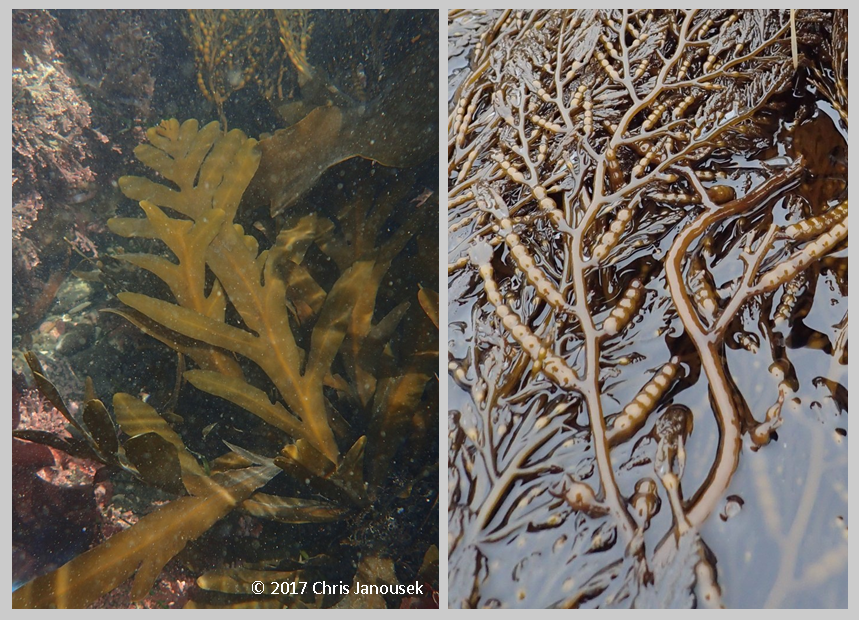
Large brown seaweeds in the low intertidal at Shelter Cove. Laminaria setchellii (left)
and Stephanocystis osmundacea (right).

Pterygophora is a species I typically associate with subtidal kelp forests. Curiously, however it was common in the low intertidal zone at all three sites I visited in northern California for the long weekend. Another very common large brown species at Shelter Cove was Stephanocystis osmundacea (older name = Cystoseira osmundacea). Attached by a tough, almost woody base, this species is large enough to form underwater canopies like several of the kelps, but it is classified in a different order of brown seaweeds. The basal portion of the plant consists of flat pinnately-divided fronds. The top portion is more wiry in morphology and contains the most attractive part of the plant in my opinion: the concatenated pneumatocysts that look like strings of brown pearls, and which function by virtue of holding gases to keep the upper part of the plant afloat.

Stephanocystis osmundacea at Shelter Cove. Basal fronds underwater (left) and
apical portion of the plant with pneumatocysts (right).

The low intertidal into the shallow subtidal was littered with small cobbles which were covered in crustose coralline algae, brightening the substrate with pink and white. Because of their smaller size, the cobbles are likely unstable during periods of high surf, impeding any hope of long-term residence by fleshy seaweeds. The slow-growing, calcium carbonate-encrusted coralline algae however, seemed to find this sufficiently acceptable habitat.

Underwater branching and encrusting coralline algae at Shelter Cove.

In the low intertidal, a little above the water line, I soon discovered my first abalones of the day tucked into a tiny rocky ledge. There were nine individuals! In my experience, it is relatively unusual to find more than a few scattered individual abalones on any stretch of California coastline, but by the end of my wanderings that morning, I ended up counting some 77 or so over about 200 m of coastline.

Red abalones, Haliotis rufescens, in the intertidal at Shelter Cove.


The abalone hunters are well aware of the bounty present at Shelter Cove too. In fact, as I was likely the lone (bipedal) seaweed enthusiast at Shelter Cove that morning, I was quite outnumbered by divers wading in the shallow subtidal with wetsuits and donut-shaped floats looking for specimens of legal size. I have personally never tried the apparent delicacy of the expertly-prepared abalone. Despite my deep enjoyment of many things oceanic, I have generally never been too particularly interested in seafood.

Abalones are even more dedicated seaweed enthusiasts than me, feeding on kelp or other species of macroalgae. The slow-moving mollusks clamp down on a bit of sea salad as it floats by. For some species of abalone, an animal’s choice of seaweeds to dine on can be reflected in shell color. Consumption of red seaweeds, for instance, will lend the shell a reddish color from the pigment rufescine.

Abalones are gastropod mollusks, related to snails, limpets, and slugs. They occur worldwide, but attain their greatest size in the Pacific basin. Along the Pacific coast of North America there are seven species: red, black, green, pink, pinto, white, and flat.

Of these species, red abalones (Haliotis rufescens) seem to be the most common in northern California. It was this species I noted in relatively high abundance at Shelter Cove. The visible part of the tough muscular foot is black in color, protected underneath a generally pinkish to reddish pearly shell. A row of perforations near the margin of the shell are the site where gills expel water. In California this is the only species that can be fished, and even then, it can only be taken north of San Francisco, and by free diving, and during certain periods.

The only other abalone species I definitively recall seeing in the rocky intertidal is the black, H. cracherodii. I found a rare cluster of these organisms while tidepooling at Carmel Pt. south of Monterey in December of last year. Like some of the reds at Shelter Cove, these animals were wedged in a rock crevice. Black abalones occur from Mendocino County south to Baja California and can live at higher elevation in the intertidal than other species.

Black abalones, Haliotis cracherodii, in the intertidal at Carmel Pt.,
Monterey Co., CA, Dec 2016.


Unfortunately abalones tell a tale of coastal resource exploitation. After 20 years of tidepooling throughout California, my experience suggests it is relatively rare to see abalone in any significant number in the intertidal zone. Yet this was not always the case. Older photos from southern California decades ago show intertidal abalones in incredible abundance, covering much of the surface of the rock and crawling on top of each other! Overfishing, El NiƱo, and disease appear to have contributed to the severe loss of these important coastal ecosystem members. With declining numbers, rehabilitation of populations is now the key focus for these organisms.

Not all west coast species are equally threatened. While a fishery still exists for reds, white abalones (H. sorenseni) are so rare in the wild that they are in danger of going extinct. This species lives in southern California and Baja California in deeper waters. Whites were the first species of marine invertebrate to gain a federal listing of endangered in the United States. NOAA estimates that several thousand individuals still exist in the wild, but these adults may be the last cohort of a species at the edge of extinction. Mating success is dependent in adults being close enough to each other that sperm and eggs have a chance of meeting.

A group of researchers housed at UC Davis’s Bodega Marine Laboratory, are working hard to help recover this species. Black abalones are also federally endangered, having experienced a severe population decline in the last few decades.

References

Calif. Dept Fish Wildlife. No date. White Abalone Recovery Project.

Morris RH, Abbott DP, Haderlie EC. 1980. Intertidal Invertebrates of California. Stanford University Press, Stanford, CA.


NOAA Fisheries. 2016. White Abalone (Haliotis sorenseni).

Ricketts EF, Calvin J, Hedgpeth, Phillips DW. 1985. Between Pacific Tides. 5th ed. Stanford University Press, Stanford, CA.

Dermasterias imbricata at Shelter Cove.
Stephanocystis osmundacea from below.