Showing posts with label John Muir. Show all posts

07 August 2017

John Muir Wilderness III

Mt. Humphreys, John Muir Wilderness.
Monday, 31 July 2017.

Morning, Piute Lake. Clouds 0%. Last evening’s storm and clouds have given way to a warm, calm, sunny morning. The sun, still relatively low in the sky to the east, at the left of the canyon, highlights the numerous flat granite slabs that were worn smooth by past glacial action. They are shining in the sun. In fact, the rock on which we’ve been cooking meals near the tent is one such stone, polished by past glacial scouring.

The busy cascade of water feeding into the west end of Piute Lake provides a constant backdrop of singing, but the morning melodies of birds that so often accompany camping and hiking trips, seem mostly muted here. The consistent nuisance is mosquitoes, which are out at all times of the day. Though not terribly abundant at most times, one wastes time swatting at them, trying to ensure that if they do bite, you are their last meal. One wonders how these parasitic creatures can be so numerous here. Potential victims do not seem abundant themselves, whether that is backpackers or other mammals. During the trip I have seem some marmots, a hare, and a few other small mammals, but no wildlife in abundance. I like almost all forms of life, but have a hard time appreciating the likes of mosquitoes, tapeworms, and ridiculously shaved poodles.

Meadow of shooting stars and valley to the west.
Late morning, Humphrey’s Lakes area. Clouds 15%. We climbed over Piute Pass to the west again, and this time veered in a more northerly direction into the extensive fields of granite south of Mt. Humphreys. MWS’s map indicated that numerous lakes were present in the area, mostly small, and from a little bit of a high vantage point I can already seen ten of them.

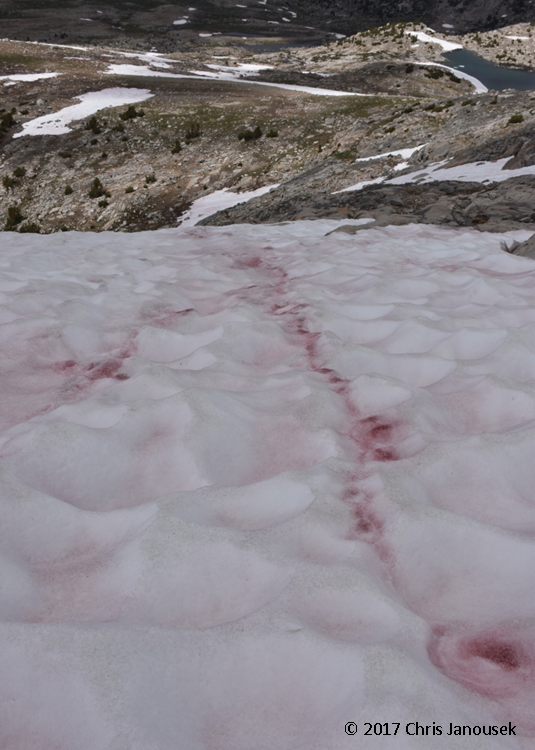
Afternoon, Piute Pass. Clouds 70%. We wandered back towards the pass through the tree-less granite fields passing more snowfields and a tiny lovely meadow that was populated with many pink blooms of shooting stars (Primula fragrans). Looping over the ridge just north of Piute Pass we found a delightful area of alpine gardens full of shrubby pines, pink mountain heath (Phyllodoce breweri), other flowers, and abundant water flowing in creeklets merrily to the east. One major creeklet is almost a stream, forming cascades and mini-waterfalls before plunging beneath a snowfield creating a snow cave! I squatted below the fragile lip of the snow cave, getting sprayed by the creek and observing again streaks of red algae in the firm snow. Also in this area we found a “peeing rock”, literally a fine stream of water shooting out two feet horizontally from a vertical rock face which had a small hole in it.

A small mountain stream plunging into a snow cave near Piute Pass.
MWS pretending to drink from the "peeing"
rock near Piute Pass.

After heading down from Piute Pass back towards camp, we rambled again off trial for a time, observing a collection of creeklets that meandered through beautiful meadows. There were more water cascades and small waterfalls. I also found a new delightful shrub (Rosaceae probably) with white petaled flowers and a lovely fragrance. Back at camp I took an exceedingly brief plunge into Piute Lake, lasting just a few seconds in the very cold water. The mosquitoes have been less bothersome today.

Evening, Piute Lake. Clouds 60%. On a rocky ledge a short distance WNW of the campsite, I discovered a small grove of quaking aspen, mixed with some pines. The plants graded in size from small shrubs to very small trees, some with their heart-shaped leaves dutifully fluttering in the evening wind. The woody stems of the plants vary in color from silver to orange and the leaf petioles are red, feeding into the green leaves. This is the highest elevation population of aspens I have seen on the trip. There are grey clouds to the east and west ends of the valley, but no rain as of yet, though I can see vertical streaks in the sky towards Owens Valley where there are probably showers. The half moon, bright in the sky to the south, is about 45 degrees above the horizon. The lake is rippling gently with the evening breeze and is a dark green color to the south, grey shimmers to the east.

Snow algae and snow "craters" in the Humphreys Lakes area.

For my last saunter of the day, I climbed the granite rubble that slopes up at the north end of the valley to inspect the base of a small waterfall that seemed to be a constant source of sound in the valley. A ribbon of vegetation followed the water’s course down the otherwise mostly barren slope. It was populated with sedges, red paintbrushes, Achillea millefolium, Delphinium, and abundant rosaceous shrubs with prolific yellow flowers. There is a slight fragrance in the air too, perhaps due to the latter species. The sky is beginning to turn pink to the west and night will come soon.

Reference

Wenk E. 2015. Wildflowers of the high Sierra and John Muir trail. Wilderness Press, Birmingham, AL.

Granite boulders that may have been left by retreating glaciers.
More snow algae, a partially covered lake, and Mt.
Humphreys in the background.
A spike of Pedicularis sp. flowers, John Muir
Wilderness.

06 August 2017

John Muir Wilderness II

Sunday 30 July 2017.

Muriel Lake and Mt. Humphreys in the background.
Midday, North of Goethe Lake. Clouds 15%. MWS and I crossed over Piute Pass again in the morning after camping for the night near Piute Lake. Veering off the main trail a little towards the south, we followed a remnant of another trail but were soon off the marked path. We arrived at Muriel Lake, an irregularly shaped and scenic alpine lake, with glacial rubble and red-tinted snowfields in the vicinity. A few very small icebergs were floating in the water, calved from a shelf of snow abutting the western shore.

Rounding the northern point of Muriel Lake, we proceeded south, gaining some elevation and eventually obtained a grand view of Goethe Lake, an unnamed smaller companion lake, Mt. Goethe (13,270 ft), Muriel Peak (12,937 ft), and the Goethe Glacier. The glacier, which was the original intended destination, was set in a rocky enclave, about halfway in height between Goethe Lake and the top of the rugged mountain ridge to the south (to which the Muriel and Goethe peaks contributed). Beyond the ridge to the south is the wilderness of Kings Canyon National Park. Meanwhile to the north, the whole morning while hiking, tree-less Mt. Humphreys (13,992 ft) was visible, an impressive monument of sharp jagged brown rocks dressed on its side with a checkerboard of not-yet melted snow patches.
Goethe Lake (left) and Gothe Glacier (right photo at center).

Goethe Lake and its unnamed companion were stunningly beautiful, perhaps my favorite of the trip. At this season, both lakes were a mix of open water and floating ice. The unnamed lake had a brilliant patch of turquoise water towards the southern end and elsewhere the water of both lakes was a deep vibrant blue. The glacier was mostly white, and unexpectedly so to me, for I had anticipated being able to see bluish ice. In place of blue, it had some vertical streaks of dirty green that I assume are outcroppings of ice.

The whole Goethe landscape was ruled by granite and snow and beautiful lakes, sparse in life, but abundant in majesty and contrast. The afternoon of our hike, the air was warm with a cool breeze belying the assured harshness of the landscape in the dead of winter. There were still trees at our elevation (~12,000 ft), but they mostly took on a shrubby growth form. Mosses, grass, and flowers – all of short stature – were present too, but they must be subject to the realities of a short growing season.

A panorama of about 180 degrees, from Mt. Humphreys in the north to Goethe Lake and Goethe Glacier to the south.

A prominent streak of snow algae near
Lake Muriel. 
The snowfields in the wilderness have presented really attractive patterns and colors to me. Many are tinted red or pink from algae living within the hardened snow. My friend recently provided an excellent overview of this “watermelon snow” in her blog here, and you can read more about the algae here. I’ll only repeat here the main fact underlying this phenomenon – namely, that the organism responsible for the unusual streaks of color is a green alga, Chlamydomonas, which produces brilliant carotenoids (orange, yellow, and reddish pigments responsible for the color of carrots and autumn leaves). In the John Muir Wilderness, the alga was present on many of the snowfields.

My other snow observation was the pattern of regular undulations in the surface of many of the snow fields, some craters exceeding a few feet. I’m unsure how these craters form, but they seem to arise from the melting process, not from the original deposition of snow. Most of the snowfields were very firm – approaching ice – and it was relatively easy to walk across them in hiking boots.

A fortuitous granite "tent" provided some
relief from the sun.


Early afternoon, NW of Goethe Lake. Clouds 25%. We climbed a bit higher to the top of a ridge (~12,080 ft) that separates the Goethe Basin to the east and the Wahoo Lakes basin to the west. Like Goethe Lake and its unnamed companion lake, the Wahoo Lakes have icy surfaces, not solid but broken up on the surface. I was worried about sun exposure, but found a little shade (a scarce resource in this nearly treeless alpine area) in a tent formed by two slabs of salt and pepper granite that learned against each other. The sun here is intense and the clouds are mostly to the east and north of our location, providing little relief.

We returned to the campsite in the afternoon. By late afternoon and early evening cloud cover increased to 75% as the afternoon progressed on the west side of the pass. The valley grew grey and soon thunder announced her presence. I remarked earlier in the day how I thought it would be great to have a Sierra thunderstorm, and here she was! A dozen or so lightning strikes clapped to the east and then rain and hail fell in a marvelous summer storm. The downpour was intense for a short time, sending a barrage of precipitation into Piute Lake. After no more than about an hour the storm passed, but the sun never fully returned to the valley for the day, leaving grey clouds, cool air, and wet ground for the evening. At sunset, a reddish haze appeared in the west; purple and red skies in the east.

A brief video of the storm:


Small icebergs at the edge of Muriel Lake.
USGS topographic map of part of the John Muir Wilderness (Mt. Darwin quadrangle, 2015), including some of the areas we explored on the second day of the backpacking trip (red dotted line).

05 August 2017

John Muir Wilderness I

Saturday 29 July 2017

Bog orchid and tiger lilies, John Muir
Wilderness.
Morning, Piute Pass Trail. Clouds 1%. Backpacking trip with MWS. From the North Lake campsite in the Inyo National Forest we began the trail westward and upward towards Piute Pass in the John Muir Wilderness. The trail began through a forest of quaking aspens (Populus tremuloides) and pines. There was quickly a diversity of beautiful blooming species including orange tiger lilies (Lilium sp.) and spires of white bog orchids (Platanthera sp.).

After hiking for some time, we began to lose the shade of the forest to more open areas of rocky granite. The flower composition changed too with the more open terrain – now there were abundant Castilleja (paintbrushes) and salmon pink Penstemon. We stopped for lunch at the shore of the first major lake, Loch Leven (elev 10743 ft), a small tranquil alpine body of water about halfway between the trailhead and Piute Pass. There were more pines on the north side of the lake and a few shrubby willows. On the bright, treeless slopes there were yellow wallflowers and small plants with clusters of dainty white flowers bearing variable 4-6 petals each.

Whitebark pine, John Muir Wilderness.


Afternoon, Piute Lake. Clouds 3%. Continuing up the trail toward the west we found a shady soft patch of carpeted ground at the northwest end of the lake, shaded by a group of whitebark pines (Pinus albicaulis) which will be base camp for the next few days. The terrain around the south side of the lake near our camp was mostly granite slabs and boulders but the pines were present in respectable densities. Also in the landscape mix were tiny little meadows of sedges and other graminoids. The rocky ridges of grey granite forming the canyon walls were mostly unvegetated to the north and south. Both sides of the valley had patches of snow, but it was more common to the south where the sun was less direct. The moon is a quarter crescent in the east.

Piute Lake (foreground) and Loch Leven (background).

Evening, Piute Pass. Clouds 0%. After setting up camp, we walked the remaining distance up to the pass to the west to observe the sunset. The basin opened up to the west and was surprising barren upon first sight in the evening. It was devoid of trees but had numerous lakes. I initially did not think the view was as impressive as I imagined, but my feelings would change tomorrow when we would hike into the basin.

Sunset at Piute Pass (left) and nighttime view of the Milky Way from Piute Lake (right).

16 January 2017

Muir's "sea mosses"

At the turn of the year, I visited the John Muir National Historic Site in Martinez, California. This was my second visit in under a year (I wrote about Muir's life and my previous visit here). My time wandering about his house was more intentional on this recent trip and I took a closer look at the house and the historical items on display inside.

It wasn't long before I discovered an intriguing item in a display downstairs: seaweeds! Muir was a botanist of course – godfather of the giant sequoia, wildflower enthusiast, and a collector of plants on his thousand mile walk to Florida – but I had no idea that he had collected marine algae!

A few specimens of Microcladia coulteri on display at the Muir National Historic Site in Martinez, California.

Muir's "sea mosses" were collected in Pacific Grove on the Monterey Peninsula in central California, a location that has long been popular with seaweed enthusiasts. For example, some of the 100+ year old specimens of marine algae that I've had a chance to observe in the University herbarium at Berkeley over the years were collected at Pacific Grove.
Microcladia coulteri (center) on Chondracanthus
exasperatus
(right) at Carmel Point, Monterey Co., CA,
June 2014.

The plants on display appear to be Microcladia coulteri, a common species in central and northern California. M. coulteri typically grows as an epiphyte on other red seaweeds such as Mazzaella and Chondracanthus. It is a fantastic species for the artist since it dries easily, adheres to herbarium paper readily, and has such a beautiful branching pattern.

Muir’s seaweeds were pressed on small pieces of paper and assembled into a book as a gift for his sister. A few loose plants are on display next to the booklet (it is uncertain if they were pulled out of the booklet). The loose plants are still in good shape. Seaweed specimens can last hundreds of years if they are mounted on acid-free paper and preserved carefully. I’m not sure how Muir obtained the specimens – if they were washed ashore or even given to him by another naturalist – but it is fun to think of him in suit and hat, knee deep in chilly water at low tide, marveling at the botanical and zoological treasures of the intertidal universe.


30 October 2016

Muir: advocate for the wild

At a bookstore in Portland in July I purchased a biography of John Muir by history professor Donald Worster. An excellent book, I gradually read it over the last few months. For a decade Muir has been a significant role model for me. My first substantive introduction to his writing was towards the end of graduate school when my mom bought me a book with a collection of his writings. Muir's romantically-infused view of nature, his attentiveness to natural history details, his wit regarding our own species, and his deep love of nature's beauty all resonate deeply with me.

President Teddy Roosevelt and John Muir at Glacier
Point overlooking Yosemite Valley in 1906. Image
in the public domain.
Muir is widely regarded as the godfather of Yosemite, of the National Park System, and of wilderness as a human value. He grew up in Scotland in a stern religious household, immigrated with his family to Wisconsin during childhood, and began to study science at the University of Wisconsin, though he did not complete his degree. The youthful Muir was an inventor and interested in mechanical innovation and efficiency. For instance, he built several versions of an alarm-clock bed that would rudely tip him to his feet at the appointed time early in the morning! His early career was spent in factories where his proclivity towards innovation bore fruit, but that left less time for indulging in his interests in science. An alarming accident in the factory that nearly blinded him helped him re-evaluate his life’s direction. Muir soon thereafter gave up factory work, moved to California – and scarcely giving any attention to the shiny city of San Francisco where his ship landed – headed for the Sierra Nevada.

Muir would end up spending years living in and exploring Yosemite and the nearby Sierra range. Though he lacked higher academic credentials, he would eventually help decipher from the rocks that the great valleys of the Sierra were formed by the slow action of glaciers, even though leading geologists of the time tended to favor other, incorrect theories. Muir also traveled beyond his beloved Yosemite to other regions of the west - to Mt. Rainier, to the Great Basin, and on seven different trips, to the recently acquired US territory of Alaska.

A panorama of forest in Sequoia National Park, August 2014. Crowns of giant sequoias (Sequoiadendron giganteum) in Muir Grove can be seen at top center. From a glacier to a wilderness area in the Sierra, to a beach, Muir has numerous natural landmarks named after him throughout the western United States.


Worster’s biography shed some light on aspects of Muir's life that I didn’t know or that I under-appreciated. By hard work and financial thrift, he gradually grew into a life of significant financial and social comfort by his later years. This was an interesting point of contrast for a man who was perfectly happy to sleep outside below the stars or who packed little but tea and bread for several days of wandering in the wilderness. In addition to his exploration throughout the western US, he also took several long international journeys (traveling to most continents) and he spent a significant amount of time in the deserts of the southwest, though he is mainly known as the patron saint of the Sierra. Finally, I learned that he actually camped with not one, but two, US Presidents who made visits to California (Roosevelt and Taft).

Muir's life was a celebration of nature, and on the time scale of history he had a tremendous impact on conservation and natural resource protection, but his life ended on a sad note. For years, he was involved with others in a political battle to save the beautiful Hetch Hetchy valley in Yosemite National Park from drowning under San Francisco's uncompromising push for urban growth and consumption. For a time it seemed that the proposed dam Muir strongly opposed would be put on hold for at least a generation, but in the end other political forces prevailed and Yosemite Valley’s northerly twin granite cathedral was allowed to drown to become a reservoir. The valley remains underwater today.

Muir epitomized aesthetic love of nature, but he was a pragmatist too and did not object to mankind’s use of natural resources or natural areas. His lifetime spanned a great period of technological and engineering advances (the mid 1800s to early 1900s), which perhaps accelerated the pace and degree to which human intervention in the natural world could leave lasting imprints. He was favorable to industrial advances, but he advocated for a much greater emphasis on conservation than most of his contemporaries. He didn’t see industrial or agricultural progress as an enemy, but rather recognized that true human progress depended on a deep reverence for, and sufficient protection, of nature. Today, he would likely be astounded at just how far humankind has impacted every ecosystem on earth, but perhaps he would also be relieved that his successors have set aside some of the most inspiring natural places as wildernesses and national parks.

----

I stumbled upon Muir’s old mansion in Martinez, California inadvertently this summer while car shopping. Just off the highway, a National Park Service sign appeared across the road which marked the house and orchards where Muir spent the last decades of his life. It was originally owned by his father-in-law but eventually came to be owned by the naturalist. After an uneventful visit to the car dealership, we stopped at the visitor’s center and then toured the house and grounds.

The Muir mansion in Martinez, California. The photo at right is Muir's office, which he called his "scribble den".

The Muir-Strentzel mansion is perched on the top of a small hill. It is spacious with several stories, a large kitchen, a green-house like room on the east side of the building, and a small bell tower. There are fancy chandeliers. Muir had an office on the second floor across from his bedroom where a desk sat below windows that open up to the Alhambra Valley to the north. Here he worked on patching together old field notebooks and other scraps of text into the wonderful nature writing we have today.

Out on the grounds the fruit trees have been preserved by the Park Service, perhaps including some of the original trees that Muir, his family, and hired workers tended. He was a successful and hard-working business man, turning a good profit on the property. The mansion and grounds are not the expected scene of a lover of all things wild. Yet, down the slope from the house also grows a single tall Sequoiadendron giganteum specimen too, planted by Muir.

----

Writing apparently came with great difficulty to Muir, though in books like My First Summer in the Sierra, I've felt his words flow with grace and ease. He frequently used superlatives, even religious language, to describe the landscapes impressed on his mind. To Muir, the geologic labor that built cathedrals like the Yosemite Valley was superior to anything humankind could construct. His early writings consisted of articles for periodicals published on both the east and west coasts. He was able to introduce the marvelous natural areas of the west to eastern readers who had never seen the less-densely populated areas of western North America. His books tended to emerge later in his life (or even shortly after his death); in some cases they were re-workings of his shorter essays.

A photo of Hetch Hetchy Valley in Yosemite National Park taken by Isaiah
Taber in the first decade of 1900s, before the valley was flooded. Image in
the public domain.
One of the refreshing hallmarks of Muir’s writings is his near complete avoidance of politics, and even of human actors and voices. He was intimately involved in the politics of conservation towards the end of his life, but that was a necessary evil to protect his beloved wild places, not a manifestation of a propensity towards the political life. Muir’s pen focused on nature, and if there is a lesson to be had from his approach for my own attempts to write about nature, it is the power of letting the organisms have the main voice in the narrative.

Muir had a profoundly different perspective on the natural world than many of his contemporaries, or even of many people alive today. As I came to the conclusion of Worster’s biography, it seemed to me that Muir's greatest concern over how humans interacted with nature was the inability of most to see beyond money. Such a narrow focus could afflict both the poor and the rich of his day - the rich because they were willing to sacrifice the irreplaceable beauty of nature for short-term monetary gain, and the poor because they were confined to a system that kept them focused on economic concerns for their very daily survival. Muir advocated for recognizing the true wealth of nature and its irreplaceable value to humankind. Nature is the wealth of eons of history, accumulated by slow but ruthless and elegant forces of biology and geology. Nature reminds us of what is insignificant and unimportant. Nature inspires our aesthetic and spiritual aspirations as a species.

“How fiercely, devoutly wild is Nature in the midst of her beauty-loving tenderness! – painting lilies, watering them, caressing them with a gentle hand, going from flower to flower like a gardener while building rock mountains and cloud mountains full of lightening and rain. Gladly we run for shelter beneath an over-hanging cliff and examine the reassuring ferns and mosses, gentle love tokens growing in cracks and chinks. Daisies too, and ivesias, confiding wild children of light, too small to fear. To these one’s heart goes home, and the voices of the storm become gentle. Now the sun breaks forth and fragrant steam arises. The birds are out singing on the edge of the groves. The west is flaming in gold and purple, ready for the ceremony of the sunset, and back I go to camp with my notes and pictures, the best of them printed in my mind as dreams.” John Muir, 20 July 1869, My First Summer in the Sierra.


References

Muir J. 1911. My First Summer in the Sierra. Penguin Books.

Worster D. 2008. A Passion for Nature. The Life of John Muir. Oxford University Press.

31 May 2016

Yosemite IV: Glacier Point

Looking southwest into Tenaya Canyon
with Yosemite Valley in the distance.
I took a quick weekend trip to Yosemite this month. The waterfalls were full; the new foliage on hardwood trees was bursting forth like lime green jewels. There were two new destinations on this trip for me: a hike into Yosemite wilderness on the northwest wall of Tenaya Canyon and a drive to Glacier Point on the southern rim of Yosemite Valley. Both afforded incredible views of Half Dome, Tenaya Canyon, Yosemite falls, and the other gems lying at the heart of the park.

From atop Glacier Point it was easy to see how crowded and developed Yosemite Valley has become. Meadows, forests and the sinuous Merced River still occupy most of the valley floor, but the roads and clusters of cars are in plain view from above. John Muir described the view as follows: “From Glacier Point you look down 3000 feet over the edge of its sheer face into the meadows and groves and innumerable yellow pine spires, with the meandering river sparkling and spangling through the midst of them. Across the Valley a great telling view is presented of the Royal Arches, North Dome, Indian Canyon, Three Brothers and El Capitan, with the dome-paved basin of Yosemite Creek and Mount Hoffman in the background. To the eastward, the Half Dome close beside you looking higher and more wonderful than ever; southeastward the Starr King, girdled with silver firs, and the spacious garden-like basin of the Illilouette and its deeply sculptured fountain peaks, called ‘The Merced Group’; and beyond all, marshaled along the eastern horizon, the icy summits on the axis of the range and broad swaths of forest growing on ancient moraines, while the Nevada, Vernal and Yosemite Falls are not only full in sight but are distinctly heard as if one were standing beside them in their spray.” – The Yosemite, 1912. 

View from Glacier Point. Tenaya Canyon entering Yosemite Valley in the foreground. Half Dome to the right.
Left: Vernal Falls. Right: Yosemite Falls.

25 June 2011

Yosemite III: Hetch Hetchy

The O’Shaughnessy Dam, designed to provide water for the city of San Francisco, was in place by 1923 to drown the Hetch Hetchy Valley.  Before the valley was flooded, it was apparently comparable in aesthetic effect to the Yosemite Valley, though perhaps smaller in overall dimensions.  John Muir advocated hard to prevent the construction of the dam, but political pressures won out in the end and the valley became a reservoir.

Beautiful flowers of an array of colors were present on our mid-May hike.  Perhaps someday the valley will be restored.  It would then be many decades or centuries before the effects of the dam will no longer be apparent, but what an interesting experiment in ecological succession and restoration!