Cacti are iconic plants of desert environments. These
succulent plants occur in the family Cactaceae. There are about 1800 species
worldwide in the family, grouped into 125 genera. The family is endemic to
North and South America, distributed from southern Argentina
to Canada.
One additional species occurs in western Africa and some of the islands of the Indian Ocean.
As a group, the Cactaceae are believed to have evolved in South America about 65 million years ago (around the same
time as the extinction of dinosaurs), though molecular data suggest a more
recent origin of about 30 million years. 65 mya, South America was warm and
dry, but disconnected from North America.
Cacti spread north, using Cuba
and other islands as dispersal stepping stones, arriving in Mexico about 36
million years ago. In North America, the
western deserts expanded about 2-5 million years ago with further radiation of
cactus species.
 |
The beavertail cactus, Opuntia basilaris. Left: Plant with flower buds from Death Valley National Park, March 2016.
Right: Plant from Joshua Tree National Park, February 2012. |
Cacti are excellent plant examples of structural adaptations
to meet unique environmental circumstances. The fleshy part of a cactus is
actually the stem. In many species the stem is succulent, allowing for water
storage in the dry habitats where they live. Water is stored in the stem's
parenchyma cells. Stems have additional adaptations to minimize water loss such
as the presence of a thick waxy outer cuticle and stomata that are sunken.
Individuals can withstand water loss of up to 70-95% because the tissues have
so much water storage potential. The longitudinal ribs present in some species
are capable of expanding and contracting like an accordion without damaging the
protective cuticle as water content in the plant varies.
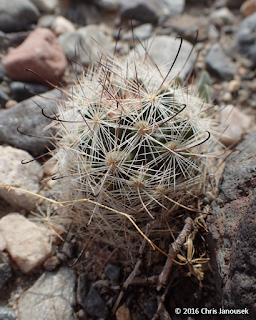 |
Mammillaria tetracistra from Panamint Valley in
Death Valley National Park, March 2016. The
black spines on this species are hooked. |
The spines of cacti are actually modified leaves. They are
non-photosynthetic but have several other functions. The most obvious is
defense against herbivores. Spines can also help a cactus acquire water when
dew condenses on them, or help shade the plant. The spines may assist with
dispersal of segments of the plant when they are caught in the fur of animals
and transported around. Some "gland spines" produce nectar which help
the plant attract pollinators.
Cacti also couple physiological adaptations with anatomical
and structural modifications to deal with arid growing conditions. Plants
acquire carbon dioxide (needed to build sugars and other organic molecules)
from the air through their stomata, but having stomata open in a hot dry
environment makes plants susceptible to water loss. One way to acquire CO2
but minimize water loss is through CAM photosynthesis,
a variation of C3 photosynthesis present in most other plants. In CAM species the stomata remain closed during the day, but
then open at night to acquire CO2 when the potential for water loss
is reduced. Carbon dioxide captured at night is temporarily stored as an acid
in the cells and later used to build sugars.
According to the recent Jepson manual, California has 37 native species of cacti.
On my trip to Death Valley last month, I
observed at least five of those species. Two species were particularly common:
the beavertail cactus and the clustered barrel cactus. The beaver tail belongs
to the genus Opuntia, plants which
are also known as prickly pears. Prickly pear stems grow as segments, appearing
as upside down tear-shaped fleshy leaves. In early March flower buds were
forming on the beaver tails (O. basilaris)
but I was too early to see open flowers.
 |
Examples of Echinocactus polycephalus from Death Valley National Park. Incidentally, the Greek
etymology of this species name is fun: 'spiny cactus of many heads'. |
Another relatively common cactus at Death
Valley was the cholla, a group of cacti classified in the genus Cylindropuntia. I was first introduced
to chollas as an undergraduate student when my marine ecology field class
traveled from Santa Cruz to northern Mexico through the Arizona desert. We were warned to avoid
touching these plants because of their menacing barbed spines which can be
difficult to remove from the skin. Chollas have cylindrical stems that also
occur in segments like the prickly pears. The small stem segments break off and
lay on the desert floor. California has 10
species of cholla and I've also observed specimens of this genus in Joshua Tree
National Park, northern Arizona, and Sonora Mexico.
 |
Cholla from Joshua Tree National Park, Feb 2012. These plants are so densley covered in light-colored spines
that one can hardly see the green stem. It is possible that the dense covering of spines helps reduce water
loss from the plant. |
References
Baldwin BG, Goldman DH,
Keil DJ, Patterson R, Rosatti TJ, Wilken DH. 2012. The Jepson Manual. Vascular
Plants of California.
2nd ed., University of California Press, Berkeley, CA.
Ingram S. 2008. Cacti, agaves, and yuccas of California and Nevada.
Cachuma Press, Los Olivos, CA.
Zomlefer WB 1999. Guide to Flowering Plant Families. The University of North Carolina
Press, Chapel Hill, NC.


